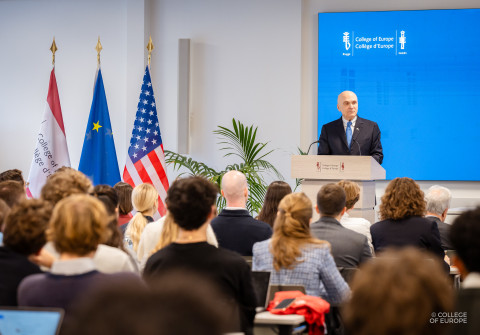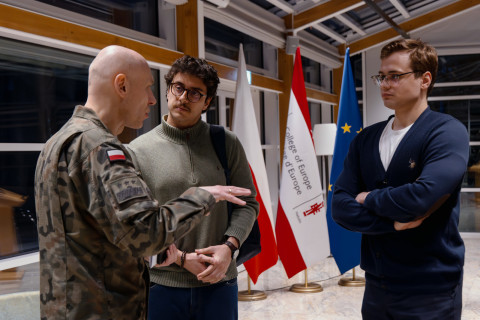
Cette spécialisation aborde certains des défis contemporains les plus pressants auxquels l’Europe et l’Union européenne sont confrontées. Les guerres qui éclatent aux frontières extérieures de l’UE et dans son voisinage constituent une réalité tangible, dont les conséquences à long terme sont considérables pour l’Union, ses États membres et ses institutions. Cette spécialisation s’appuie sur la situation géographique particulière du campus de Natolin et sur l’expertise considérable que le Collège d’Europe y a développée au cours des deux dernières décennies.
La spécialisation associe une compréhension interdisciplinaire des dimensions internes et externes de l’Europe à une analyse approfondie des enjeux de sécurité, de défense, des questions militaires et des rapports de force, ainsi qu’au raisonnement stratégique et aux processus décisionnels.
Programme académique
Master en études interdisciplinaires européennes : spécialisation Sécurité et stratégie européennes
Le Collège d’Europe se réserve le droit de modifier son programme académique, sous réserve des décisions de son Conseil académique. Les programmes d’études sont réexaminés chaque année afin de garantir leur qualité et leur pertinence continues.
PREMIER SEMESTRE
Cours introductifs
Cours fondamentaux
Études régionales européennes
- BUTTERWICK-PAWLIKOWSKI, R. – East-Central Europe, 1815-1940 (14h)
- MINK, G. – L'Europe centrale et orientale depuis 1940 (16h)
Enseignements pluridisciplinaires
- LORD, C. – EU Institutions and Decision-making (20h)
- VAN ELSUWEGE, P. – The EU Legal Order: Rights, Norms and Values (20h)
- WESSELS, W. – EU Economic Governance (20h)
Enseignements interdisciplinaires
- AUER, S. – The Sources of EU Power in Times of War (20h)
- HEUSER, B. – Theories of War and Dimensions of Strategy (20h)
- SLOAN, G. – Geo-politics (20h)
Cours contextuels
- ALI, A. – The Use of Force in International Law (10h)
- DAOU, F. – Ethics and Religion in Armed Conflicts (10h)
- MILEVSKI, L. – Making Sense of Military Strategy (8h)
- SCHLENKER, D. – External Relations, Security and Defence through the Prism of EU Historical Documents (10h)
- WIGELL, M. – Geo-economics (10h)
Études régionales européennes
- CICHOCKI, M. A.; DĘBSKI, S. – Cold War Strategies from the Central Eastern Europe Perspective (10h)
Masterclasses
- ANDRZEJCZAK, R. – Military Strategy (8h)
- LUNGESCU, O. – Communicating Security (6h)
Jeux de simulation
- MINK, G.; CICHOCKI, M. A. – Drafting a Peace Treaty for the End of the Cold War (10h)
- BUTTERWICK-PAWLIKOWSKI, R. – The Paris Peace Conference of 1919-20 (10h)
Master’s thesis and Research strategies and tools
In addition to the courses they take during the first and second semesters, students must write and defend a Master’s thesis in English or French.
- STEINGASS, S. (coord.); BOBROWICZ, B.; CHABAN, N.; EXADAKTYLOS, T.; LONGHURST, K.; MINK, G.; ROZUMALSKI, J.; SZOSTAK, R.; VAN ELSUWEGE, P.; VANNONI, M.; WINAND, P. – Research Strategies and Tools (20h)
- Master Theses Colloquia
Voyage d’études
The first semester study trip offers students a deeper understanding of European identities and a first-hand experience of policies in practice at the EU’s borders. The study trip is an integral part of the academic programme, participation is obligatory and students are expected to attend all related conferences and activities.
2ND SEMESTER
Cours specialisés
Civilisation Européenne
- CICHOCKI, M. A. – From the Greek Agora to the Ukrainian Euromaidan and War: the History of Ideas of Democracy in Europe (20h)
- LEWIS, M. A. – Crimes against Humanity, Genocide, and International Justice (20h)
- MINK, G. – Histoire, mémoire, usages et mésusages politiques, de la Seconde Guerre mondiale à Poutine (20h)
- MOORHOUSE, R. – Totalitarian Ideologies and Dictatorships in Twentieth-Century Europe (20h)
- SEGRETO, L. R. – Europe and the Global Economy from the Industrial Revolution to the Internet (20h)
- STODDARD, E. – Changing Character of Warfare from Antiquity to the Present Day (20h)
- WONGSURAWAT, W. – The End of Empires: Decolonization of Asia with comparative references to Africa and Latin America (20h)
Architecture de sécurité Européenne
- TARDY, T. – L’environnement stratégique européen : évolutions et défis futurs (20h)
- POPOWSKI, M. - Building Resilience of the EU (20h)
- RILEY, A. – EU Security in an Economic Context (20h)
- Threats and Foresight
- GRESSEL, G. – Security and Conflict Management (20h)
- HEUSER, B. – Strategy, Planning, and Foresight (20h)
- JERMALAVIČIUS, T. – Terrorism and Hybrid Warfare (20h)
- MICHAELS, J. – Nuclear Strategy (20h)
- MICHTA, A. - Security and Military Challenges in Europe (20h)
Économie et Technologie
- CHRISTIE, E. H. - Defence Economics and Defense Innovation (20h)
- JANKOWSKI, D. - The Geopolitics of Technology (20h)
Manipulation De L’Information Et Ingérences Étrangères
- FREYTAG VON LORINGHOVEN, A. – Challenges of Multilateralism and Intelligence Cooperation (20h)
- KALENSKÝ, J. – The Geopolitics of Disinformation: Russia, the Neighbourhood, the Euroatlantic. What is the Threat and how to Counter it? (20h)
Études Régionales Européennes
Europe centrale:
- DĘBSKI, S. – Between a Rock and a Hard Place: Central European Strategic Thought And Practice (20h)
- DUIJZINGS, G. – Flow and Friction along the Danube: Globalization and its Local Discontents (20h)
- PIĄTKOWSKI, M. – The Golden Age of Central Europe: The Path from Poverty to Prosperity and the Way Forward (20h)
Europe orientale et Russie:
- GILES, K. – Contemporary Russian Foreign and Security Policy (20h)
- LANOSZKA, A. – War and Conflict in the Post-Soviet Space (20h)
- NOWAK, A. – Russian Ideologies: The Last Two Centuries (from Pushkin and Karamzin to Dugin and Putin) (20h)
- ONUCH, O. – Revolutions and Mass Mobilization in Eastern Europe (20h)
- TYUSHKA, A. – The EU, Russia and the EU’s Eastern Neighbourhood: Power, Performance, and Perceptions (20h)
- WILSON, A. – The Making of Modern Ukraine: History, Independence and War (20h)
- WOLCZUK, K. – State-building, Democratisation and Economic Transformations in Eastern Europe (20h)
Méditerranée:
- AYDIN, M. – Turkey Between Europe and Eurasia: Historical and Contemporary Evaluation (20h)
- BOURIS, D. – EU-Middle East Relations: Conflict, Peace and Security (20h)
- DEMMELHUBER, T. – Autocratization in the Middle East and North Africa: Transregional and Global Perspective (20h)
- LANNON, E. – The EU and its Southern Neighbourhoods (20h)
Balkans:
- LEWIS, M. A. – Politics and Diplomacy in the Balkans from the Nineteenth Century to the Present (20h)
- TEOKAREVIC, J. – Western Balkans: EU Enlargement, External Influences, Post-Conflict Transition (20h)
Pays Nordiques Et Baltes:
- BERGMANE, U. – The Baltic Region from the Fall of the Soviet Union to the Enlargement of the EU and NATO (20h)
Séminaires intensifs
- CORFF, O. – China's National Security and Military Policy (8h)
- FRANZA, L. – Energy Security and Conflict in the EU’s Neighbourhood (10h)
- MUNOZ, R. – EU Space Policy (8h)
- VIMONT, P. – The EU and Crisis Management in Practice (8h)
- ZAMPIERI, F. - Maritime Geopolitics (8h)
Études régionales européennes
Europe centrale:
- PUDŁOCKI, T. – The Cultural History of Central Europe from Fin-de-Siècle to Totalitarianism (10h)
Europe orientale et Russie:
- ISAACS, R. – Central Asia as the EU's Wider Neighbourhood: Power, Politics, and Foreign Policy (10h)
- SABADUS, A. – Opportunity in Adversity: Moldova’s way to energy resilience (8h)
Méditerranée:
- AL-SABBAGH, R. – Investigative Journalism in the Southern Neighbourhood (8h)
- SHEIKH, N. – Religion and the State in the EU’s Southern Neighbourhood: Politics, Authority, and Religious Movements in the Middle East and North Africa (10h)
Pays Nordiques Et Baltes:
- ALIYEV, N. – Geopolitics and Geoeconomics of the Arctic (8h)
Jeux de simulation
- TARDY, T. – NATO’s & the EU’s response to War in Europe (8h)
Coopération avec des partenaires extérieurs
- MIKOS-SKUZA, E. – Introduction to International Humanitarian Law (17h)
- Workshops in history organized in cooperation with the Max Weber programme of the European University Institute (TBC)
Voyage d’études
Le voyage d’études du deuxième semestre propose des excursions thématiques sur le terrain, en Europe et au-delà. Il fait partie intégrante du programme académique. La participation est obligatoire et les étudiants sont tenus d’assister à l’ensemble des conférences et des activités qui y sont associées.
Cours de langues
En plus de bénéficier d'un programme d'études bilingue, les étudiants peuvent bénéficier de cours de langues proposés par le Bureau des langues et du dialogue interculturel. Les langues suivantes sont proposées : anglais, français, italien, allemand, polonais, russe, espagnol et arabe. Les cours sont adaptés aux besoins individuels des étudiants et sont également axés sur les compétences transversales requises par les employeurs.