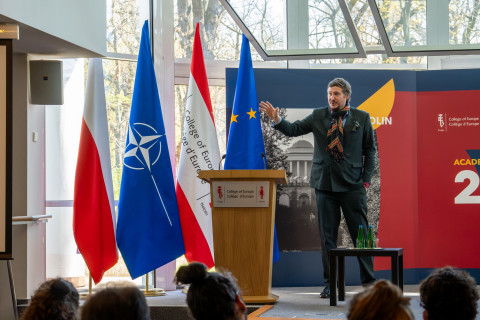
Career Day at the College of Europe in Natolin
The first Natolin Career Day has successfully concluded, marking an important milestone in strengthening the link between academic learning and professional practice at the College of Europe in...
This article is an opinion piece by current students or alumni of the College of Europe. The views expressed are those of the authors and do not necessarily reflect the opinions or positions of the College of Europe. Responsibility for the content lies solely with the authors.
By David Nagy
In this interview, Vincent Delhomme, Assistant Professor of EU Law at the Europa Institute of Leiden Law School, offers insights into choosing academia and the importance of balancing competitiveness with core European values in today’s regulatory landscape.
Question One: Why did you decide to come to the College of Europe in the first place?
Answer: I’ve always been interested in European affairs and European integration. Early on, I was involved in the Young European Federalists. While studying in Paris, I found that the programme at Sciences Po was more oriented toward economic law. During the first year of my master’s, I encountered a lot of EU law through courses such as economic law and competition law and really enjoyed competition law.
I decided to do a traineeship at the European Commission, in DG Competition, focusing specifically on State aid, and it was a great experience. I already knew about the College and wanted to pursue an LLM focused on European law. In short, I wanted a very specialised EU-law education and environment, and I could see how the College shaped people’s careers and networks.
Question Two: When you started your studies, what were your initial research interests?
Answer: At the beginning, I was drawn to competition law and the economics behind it. At that time, I was mainly interested in business economics and economic policy, but that interest later faded. I became more interested in market regulation from a public perspective and in classic EU-law questions. I was also interested in the political questions that come with economic regulation. I’ve always been interested in constitutional questions as well: such as competences, internal market, and citizenship, which are topics that relate to society and politics at a broader level.
Question Three: What changed at the College, and how did you explore your interests?
Answer: A few things happened at once. First, I had already studied a lot of competition law during my master’s before arriving at the College. That gave me a strong desire to explore new territory and delve into subjects I hadn’t studied before; it was also driven by curiosity and a wish to broaden my perspective. At the College, you suddenly have time and space, and you’re surrounded by people who are there because they chose EU affairs. So, I immersed myself in the readings and the classes. I read a lot, and that opened doors. Much of that discovery came directly through the courses, but also through personal development: through conversations, events, and reflecting on what comes after the College in professional terms. Second, the internal market and competence questions really clicked for me. My master’s thesis ended up focusing on competence issues and Article 114 TFEU, and that was a turning point: I realised I was genuinely excited by those questions.
Question Four: Your PhD topic is quite different from standard “internal market” scholarship. How did that evolve?
Answer: During my master’s thesis work on competence and Article 114, I realised that many of the cases I was reading revolved around tobacco. That became a gateway into a broader set of questions I had long been interested in: state power, freedom, civil liberties, and how the state seeks to influence individual behaviour. I’ve also been interested in topics such as drug policy, as well as the broader ideas of lifestyle regulation and lifestyle risk regulation. That’s how I ended up pursuing a PhD on lifestyle risk regulation at Université Catholique de Louvain, and I later started at Leiden University as an Assistant Professor.
Question Five: How did you realise academia was for you?
Answer: Academia was always somewhere in the back of my mind, but when I started the College, I was primarily thinking about working for the EU institutions and becoming a civil servant. What changed gradually was the intensity of my interest. I don’t think I had ever loved a topic as much as I loved what I was studying at the College. I was genuinely having fun exploring the material. I was also inspired by the work of the assistants and by speaking with them about what a PhD and an academic life actually looked like. Suddenly, all the different things I liked came together: reading, writing, and teaching. I realised this is what I want to do. I’ve always loved reading and writing, and I’ve always liked the idea of teaching, so I applied to become an assistant at the College and to pursue a PhD, which worked out.
And very practically I also started to understand the reality of the job market after the College. I realised how uncertain and long the path to becoming an EU civil servant could be, and that I was unlikely to land a position at the Commission immediately after graduation. I would still encourage people to try, but it made me think more seriously about alternative paths.
Question Six: What would you advise current students?
Answer: Stay curious. Take advantage of the fact that this is a unique opportunity for intellectual discovery, both inside and outside the classroom. Of course, make the most of the courses. But also enjoy the extracurricular life: the conversations and the unexpected interests you may discover. Use the year to learn what you genuinely like and what you don’t like to do.
And remember that the College experience doesn’t end when you leave Bruges because it’s only the beginning. I’m still very close with my College friends. Some people go into the EU institutions, others into academia, practice, or policy, and those friendships keep you connected to EU affairs in a very real way.
Question Seven: The importance of balancing EU competitiveness with core European values
Answer: I think it is absolutely important that the EU stays competitive. We are in a very different global context today, and Europe needs a strong economy to remain influential. As a scholar of the EU internal market, I also think we should focus much more on reducing fragmentation within the Single Market. Too many regulatory barriers and inconsistent implementation across Member States still make it difficult for businesses to operate across borders. Addressing that fragmentation is one of the most effective ways to strengthen Europe’s competitiveness.
At the same time, competitiveness should not come at the expense of our core standards. Environmental protection, public health, social rights, and fundamental rights are not obstacles to growth, they are part of what defines the European model. When we talk about simplifying rules through initiatives like the Single Market Strategy or the omnibus packages, we need to make sure that simplification does not turn into deregulation. Europe’s strength has always been that we combine economic development with high standards and strong protections. That is the European way of life, and it is something worth defending.
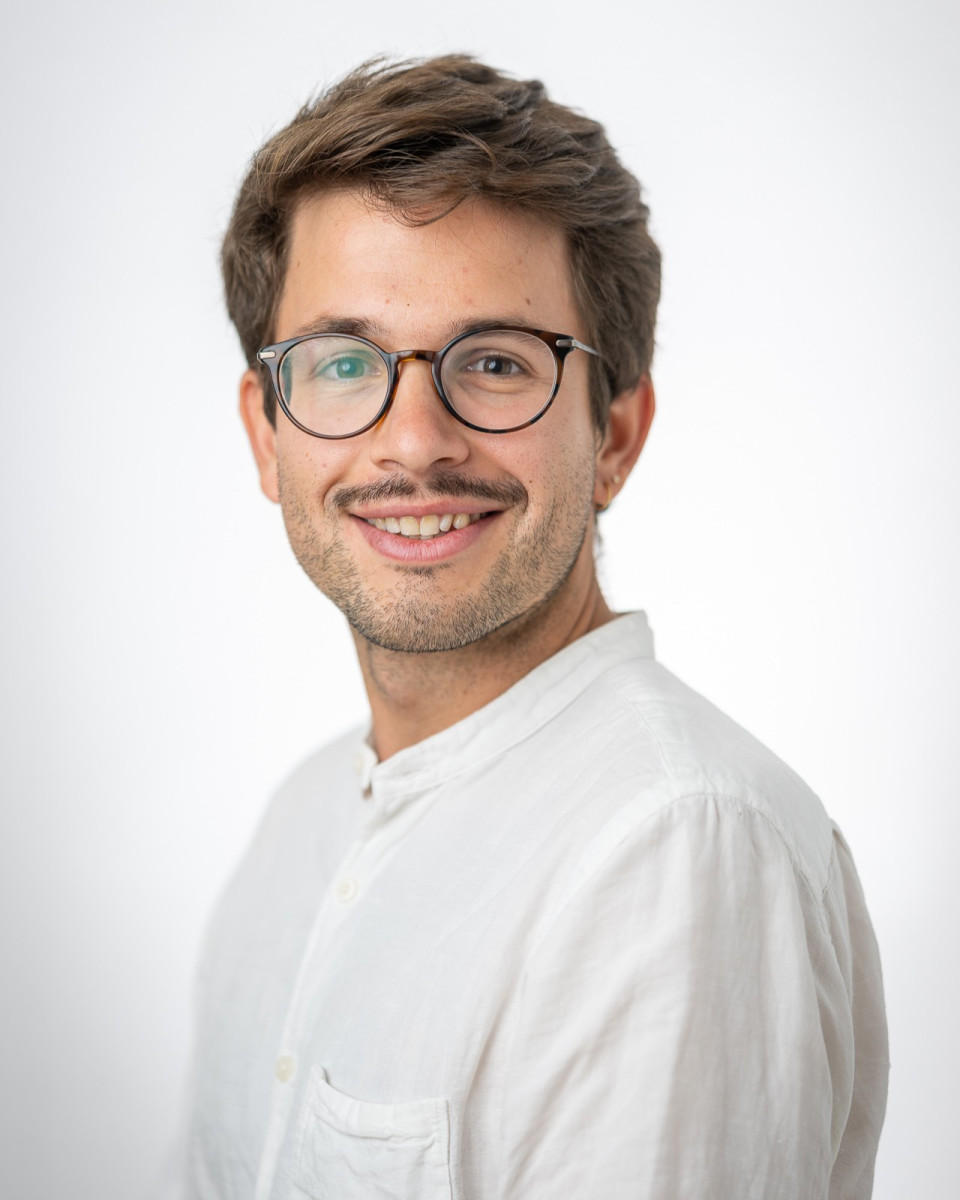 Vincent DELHOMME
Vincent Delhomme is Assistant Professor of EU Law at the Europa Institute, Leiden Law School, since 1 May 2023.
He obtained his PhD in EU law from UCLouvain in 2023. He is a graduate from the College of Europe, John Maynard Keynes promotion (2017). Vincent Delhomme researches and publishes in the fields of EU internal market law (fundamental freedoms of movement, harmonisation), EU health law (EU Health Union, non-communicable diseases, lifestyle determinants, crisis management) and food law (nutrition, sustainable food systems).
 David NAGY
David Nagy is an MSc candidate in European Economic Studies at the College of Europe and an LL.M. candidate in European Law at Leiden University.
He holds an MSc in Geo-energy Engineering from Delft University of Technology, as well as a BSc in Applied Earth Sciences with Honours from Delft University of Technology, and an LLB in Law and Economics from Leiden University. His academic profile and interests are energy and climate policy, EU law, and economics.
He currently serves as a Board Member of the Competition Society at the College of Europe.
The first Natolin Career Day has successfully concluded, marking an important milestone in strengthening the link between academic learning and professional practice at the College of Europe in...