Coming to terms with the European refugee crisis
Description
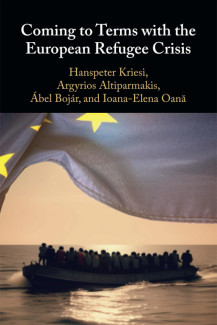
Hanspeter KRIESI [and others]. Coming to terms with the European refugee crisis. Cambridge, United Kingdom ; New York, NY : Cambridge University Press, 2024, xv, 411p.
Examines how the European Union and its member states managed the 2015-16 refugee crisis and how the institutional configuration of the EU polity shaped its response. Will appeal to readers interested in the European integration process, migration and migration policy"-- Provided by publisher.Kriesi et al. offer a comprehensive analysis of EU policymaking and decision-making during one of Europe’s most significant political crises in the last decade – the so-called European refugee crisis. Their study draws on a rich body of data, which is assessed both quantitatively and qualitatively. The authors approach the refugee crisis by breaking it down into key policymaking episodes triggered by prominent policy proposals, including the EU-Turkey Deal, the Emergency Relocation Scheme, the EU-Libya Deal, the Hotspots, the European Coast and Border Guards Reform, and the Dublin Reform. They employ an innovative methodological approach called Policy Process Analysis (PPA) to study decision-making both at the EU level and within four groups of member states: open destination countries (Germany, Sweden), closed destination countries (France, the UK), frontline states (Greece, Italy), and transit states (Hungary, Austria). Altogether, the analysis spans six policy episodes across 10 countries, examining an average of 157 (!) actions per episode, using a vast corpus of media data. This corpus is further complemented by election campaign data, surveys, and speeches, allowing the authors to explore the domestic and supranational political dynamics behind the adoption of these policies. Theoretically, they argue that the refugee crisis was shaped by the institutional dynamics of decision-making in a multi-level polity, influenced by a particular ‘policy heritage’ and a combination of problem and political pressures at both the national and EU levels. The crisis exposed vertical and horizontal conflicts typical of a multi-level polity and the asymmetric interdependence within it.The book makes three key contributions: empirical, theoretical, and methodological. Empirically, Coming to Terms with the Refugee Crisis offers the most thorough account of the political dimension of the refugee crisis to date. The authors meticulously examine various episodes, drawing well-supported conclusions based on both extensive data and existing literature. It is clear that they have become well-versed experts on EU asylum policymaking, although having previously concentrated on the political and representational aspects of immigration research. The sheer volume of empirical data analyzed, especially the qualitative elements, is highly impressive. Theoretically, the authors develop a new approach to European integration, leveraging a polity-based framework inspired by Stein Rokkan’s state-building theory (Rokkan Citation1974). This fresh perspective enriches EU integration research by adopting a Comparative Politics lens that integrates Postfunctionalism and Liberal Intergovernmentalism. The authors skillfully combine the bargaining dynamics of Liberal Intergovernmentalism with Postfunctionalism’s focus on domestic preference formation, thus avoiding common pitfalls of either approach. Methodologically, the book introduces Policy Process Analysis (PPA), a novel form of Political Claims Analysis that examines media coverage of actions related to refugee inflows both qualitatively and quantitatively. While labor-intensive, PPA promises to be a valuable analytical tool for future researchers, though it may be less feasible for smaller research projects.Despite its strengths, the book warrants some critical reflection. First, the authors are quite critical of the progress in EU asylum policy integration post-crisis, echoing existing literature that highlights the EU’s failed response to the crisis and the lack of EU capacity building (Genschel and Jachtenfuchs Citation2018; Trauner Citation2016). However, I wonder if they would maintain this assessment today. While EU asylum policy has yielded few successes from a human rights standpoint (which is not their focus), there has been notable development from an integration perspective. For example, the European Coast and Border Guard Regulations (which they address) and the EU Asylum Agency Regulation have granted the EU substantial powers in border and asylum policies. Frontex’s risk assessments and the EUAA’s country of origin (COI) information will significantly shape member states’ policy decisions, including grounds for accepting or rejecting asylum applications (Dreyer-Plum and Zaun Citation2024; Meißner Citation2019). Moreover, newer policies like the Asylum Migration and Management Regulation (outside the book’s timeframe) suggest increased EU cooperation in a new intergovernmentalist setting (cf. Bickerton, Hodson, and Puetter Citation2015). Second, the term ‘Policy Process Analysis’ may not be intuitive for those studying policy processes through methods like process-tracing, as it centers on events and actions rather than processes and mechanisms. A more fitting label might be ‘policy episode analysis’. Lastly, it would have been interesting to see how the theory developed in this book applies to other crises or EU decision-making contexts, or whether additional scope conditions are necessary. However, this is likely addressed in comparative publications stemming from the overarching project (SOLID) in which this book has been published and which examines EU solidarity in the major crises of the last decade.
Examines how the European Union and its member states managed the 2015-16 refugee crisis and how the institutional configuration of the EU polity shaped its response. Will appeal to readers interested in the European integration process, migration and migration policy"-- Provided by publisher.Kriesi et al. offer a comprehensive analysis of EU policymaking and decision-making during one of Europe’s most significant political crises in the last decade – the so-called European refugee crisis. Their study draws on a rich body of data, which is assessed both quantitatively and qualitatively. The authors approach the refugee crisis by breaking it down into key policymaking episodes triggered by prominent policy proposals, including the EU-Turkey Deal, the Emergency Relocation Scheme, the EU-Libya Deal, the Hotspots, the European Coast and Border Guards Reform, and the Dublin Reform. They employ an innovative methodological approach called Policy Process Analysis (PPA) to study decision-making both at the EU level and within four groups of member states: open destination countries (Germany, Sweden), closed destination countries (France, the UK), frontline states (Greece, Italy), and transit states (Hungary, Austria). Altogether, the analysis spans six policy episodes across 10 countries, examining an average of 157 (!) actions per episode, using a vast corpus of media data. This corpus is further complemented by election campaign data, surveys, and speeches, allowing the authors to explore the domestic and supranational political dynamics behind the adoption of these policies. Theoretically, they argue that the refugee crisis was shaped by the institutional dynamics of decision-making in a multi-level polity, influenced by a particular ‘policy heritage’ and a combination of problem and political pressures at both the national and EU levels. The crisis exposed vertical and horizontal conflicts typical of a multi-level polity and the asymmetric interdependence within it.The book makes three key contributions: empirical, theoretical, and methodological. Empirically, Coming to Terms with the Refugee Crisis offers the most thorough account of the political dimension of the refugee crisis to date. The authors meticulously examine various episodes, drawing well-supported conclusions based on both extensive data and existing literature. It is clear that they have become well-versed experts on EU asylum policymaking, although having previously concentrated on the political and representational aspects of immigration research. The sheer volume of empirical data analyzed, especially the qualitative elements, is highly impressive. Theoretically, the authors develop a new approach to European integration, leveraging a polity-based framework inspired by Stein Rokkan’s state-building theory (Rokkan Citation1974). This fresh perspective enriches EU integration research by adopting a Comparative Politics lens that integrates Postfunctionalism and Liberal Intergovernmentalism. The authors skillfully combine the bargaining dynamics of Liberal Intergovernmentalism with Postfunctionalism’s focus on domestic preference formation, thus avoiding common pitfalls of either approach. Methodologically, the book introduces Policy Process Analysis (PPA), a novel form of Political Claims Analysis that examines media coverage of actions related to refugee inflows both qualitatively and quantitatively. While labor-intensive, PPA promises to be a valuable analytical tool for future researchers, though it may be less feasible for smaller research projects.Despite its strengths, the book warrants some critical reflection. First, the authors are quite critical of the progress in EU asylum policy integration post-crisis, echoing existing literature that highlights the EU’s failed response to the crisis and the lack of EU capacity building (Genschel and Jachtenfuchs Citation2018; Trauner Citation2016). However, I wonder if they would maintain this assessment today. While EU asylum policy has yielded few successes from a human rights standpoint (which is not their focus), there has been notable development from an integration perspective. For example, the European Coast and Border Guard Regulations (which they address) and the EU Asylum Agency Regulation have granted the EU substantial powers in border and asylum policies. Frontex’s risk assessments and the EUAA’s country of origin (COI) information will significantly shape member states’ policy decisions, including grounds for accepting or rejecting asylum applications (Dreyer-Plum and Zaun Citation2024; Meißner Citation2019). Moreover, newer policies like the Asylum Migration and Management Regulation (outside the book’s timeframe) suggest increased EU cooperation in a new intergovernmentalist setting (cf. Bickerton, Hodson, and Puetter Citation2015). Second, the term ‘Policy Process Analysis’ may not be intuitive for those studying policy processes through methods like process-tracing, as it centers on events and actions rather than processes and mechanisms. A more fitting label might be ‘policy episode analysis’. Lastly, it would have been interesting to see how the theory developed in this book applies to other crises or EU decision-making contexts, or whether additional scope conditions are necessary. However, this is likely addressed in comparative publications stemming from the overarching project (SOLID) in which this book has been published and which examines EU solidarity in the major crises of the last decade.