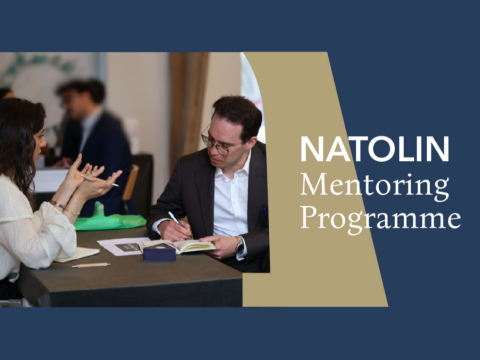
Join a community spanning Europe and the United States
MATA brings together internationally minded students and early-career professionals who want to understand transatlantic challenges, develop specialised expertise and prepare for careers across institutions, sectors and borders.
Students study within the academic communities of both the College of Europe and The Fletcher School at Tufts University while also belonging to a close-knit MATA cohort.
Two institutions · One MATA community · Two alumni networks · Careers across the Atlantic
“MATA is more than a programme. It is a truly interdisciplinary transatlantic network of hardworking and ambitious individuals, shaped as much by the experiences we share as by the diverse perspectives we bring to the classroom.
From Viennese waltz practices at Dijver and Halloween festivities at Beacon Hill to conversations in the hallways of Verversdijk and debates that continue at the Boston Public Library, MATA is distinctive in its combination of experiences, studies and scholars.
By bringing together two cities, two countries and two educational institutions, MATA offers the rare opportunity to experience two academic cultures not separately, but as parts of one transatlantic community. Above all, MATA begins as an exciting journey between two shores, but it never truly ends. It grows into a lifelong community of passionate Europeans and transatlanticists.” - Alison Wetzelaer, MATA ‘26, Former student representative
[View admissions requirements]
Is MATA right for you?
MATA may be a good fit if you want to:
- study in both Europe and the United States;
- compare European and American perspectives;
- explore diplomacy, governance, security, trade, technology, climate or other transatlantic issues;
- develop research, policy-analysis and communication skills;
- complete a professionally relevant internship;
- learn within a multinational and intercultural cohort;
- build a career with an international or transatlantic dimension.
Applicants apply through the institution at which they wish to begin their studies. Academic, professional-experience and language requirements differ by starting route.
[Compare the two application routes]
Three communities, one transatlantic experience
The College of Europe
Join a postgraduate community focused on European affairs and gain access to faculty, practitioners, career resources and alumni working across Europe and beyond.
The Fletcher School
Study within an American school of international affairs and connect with Fletcher’s academic, professional and alumni communities.
The MATA cohort
Build close relationships with students following different academic tracks and moving through the same transatlantic programme.
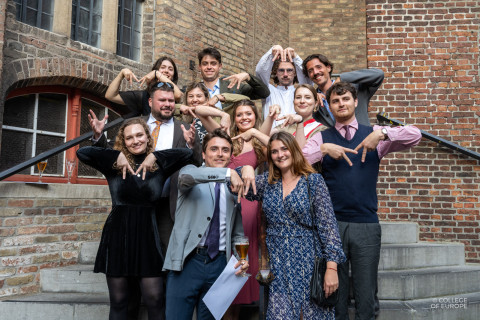
MATA Class of 2026 students share a light-hearted moment at the Mayor of Bruges’s annual reception for College of Europe students, marking the end of their first academic year in May 2025.
“MATA doubles your networking and learning opportunities. As part of the College of Europe, Fletcher and the close-knit MATA community, you gain access to both institutions’ career resources, alumni networks and faculty support.” -María, MATA ’23
Where can MATA take you?
MATA prepares graduates to analyse complex international issues, communicate across professional and cultural settings, and contribute in organisations working on European, American and global policy.
Graduates pursue careers in:
International and European institutions
EU institutions and agencies, NATO, the United Nations and other international organisations.
Government and diplomacy
Foreign ministries, national administrations, diplomatic missions, parliamentary offices and regulatory bodies.
Think tanks and research
Policy institutes and research organisations working on security, trade, technology, climate, governance and international affairs.
Consulting and public affairs
Consultancies, political-risk organisations, law firms, trade associations and corporate public-policy teams.
Business, technology and finance
Organisations addressing international regulation, economic security, trade, digital policy, energy and investment.
Civil society and academia
Foundations, nongovernmental organisations, advocacy organisations, universities and research centres.
Career paths vary according to each graduate’s experience, academic choices, internship and professional goals. The sectors above illustrate possible pathways rather than guaranteed outcomes.
Alumni pathways
Internship to employment

Antonia Wunnerlich, MATA ’26
Resident Junior Fellow, German Marshall Fund of the United States
Antonia completed her MATA internship at the German Marshall Fund in Washington, DC, where she subsequently continued her professional journey. Her work has addressed transatlantic trade, economic security, technology, cybersecurity, energy resilience and Arctic affairs.
“The MATA programme has given me the opportunity to learn from and collaborate with a host of exceptional scholars, practitioners, colleagues, and friends on both sides of the Atlantic. Over the past two years, I have studied policy challenges at the forefront of transatlantic relations today, including national and economic security, regulatory dialogue, and digital transformation. The programme consistently challenged me to broaden my perspective and expand my horizons.”
Research to international institutions
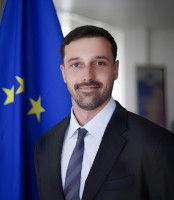
Pau Alvarez Aragones, MATA ’24
Policy Officer, DG CNECT, European Commission
During MATA, Pau completed his internship at the Center for Strategic and International Studies in Washington, DC. He subsequently worked with Baltic countries at the World Bank before joining the European Commission as a Blue Book trainee and continuing in the same unit as a policy officer.
“MATA-EIS gave me an interdisciplinary perspective that has been invaluable throughout my career. The Natolin study trip to the Baltic region directly supported my early work with Baltic countries at the World Bank. The programme’s focus on US–EU relations, technology, security and industrial policy also prepared me to contribute to Europe’s Technology Sovereignty Package during my Blue Book traineeship.”
[Explore more MATA alumni stories]
Build professional experience during MATA
Most students choose a second-year route that includes a three- to four-month, high-level internship related to transatlantic affairs.
Students identify and apply for internships independently, with access to guidance, career resources and professional networks from both institutions. Previous internships and alumni outcomes are individual examples and do not represent guaranteed placements or employment.
[Explore the MATA internship]
Two alumni networks
After graduation, MATA alumni become part of the networks of both the College of Europe and The Fletcher School. These communities connect graduates working across Europe, the United States and the wider world.
Students can also build relationships through:
- programme events;
- alumni discussions;
- study trips;
- internships;
- faculty and practitioner networks;
- College of Europe and Fletcher career activities.
[Explore the College of Europe alumni network]
[Explore the Fletcher alumni network]
Ready to join the MATA community?
Study in Europe and the United States, develop your own area of expertise and build experience for an international career.
[Explore the academic programme ]
[View admissions requirements ]
[Apply to MATA ]