The European Security and Strategy Study Track (ESSST) has been conceived in response to the growing need in Europe for expertise in the multidimensional facets of security.
Wars erupting on the EU’s external borders and within its neighbourhoods are a stark reality, carrying long-term and significant implications for the EU, its Member States, and its institutions.
The new study track deploys Natolin’s expertise to equip its students with knowledge necessary to address some of the most pressing contemporary global challenges. The College of Europe in Natolin has three decades of expertise in EU’s external relations with a special focus on the EU’s neighbourhoods. Natolin’s unique location at the EU’s external eastern border and in NATO’s North-Eastern flank offers a unique perspective
on Central, Eastern and Northern Europe.
Key features:
• Interdisciplinary understanding of Europe’s functioning
• High-level analysis of security, defence, crisis management, and power dynamics
• Study of strategic reasoning and decision-making
FIRST SEMESTER
Core Courses
Students enrolled in the EIS programme following the ESSST are required to take altogether five Core Courses. They follow both courses from the European Regional Studies (ERS) programme, one Core Course from the Interdisciplinary Option specific to their Track, and two Pluridisciplinary Option courses. They may replace one or both Pluridisciplinary Option courses with one or two additional courses from the Interdisciplinary Option within their Track, provided that they pass the relevant entry tests.
ESSST Compulsory courses
All students must follow both compulsory courses.
| Pluridisciplinary option | |
| Interdisciplinary option | |
ESSST Contextual courses:
All students are required to select two or three Contextual Courses.
- MILEVSKI, L. – Making Sense of Strategy (8h, 0 ECTS)
- SCHLENKER, D. – External Relations, Security and Defence through the Prism of EU Historical Documents (10h)
- ALI, A. – The Use of Force in International Law (10h)
- DAOU, F. – Ethics and Religion in Armed Conflicts (10h)
- WIGELL, M. – Geo-economics (10h, 0 ECTS)
- CICHOCKI, M. A. ; DĘBSKI, S. – Cold War Strategies from the Central Eastern Europe Perspective (10h, 0 ECTS) [European Regional Studies]
ESSST Masterclasses:
Simulation Games and Masterclasses are optional, with no limit on the number students may take.
ESSST Simulation Games:
Master’s thesis and Research strategies and tools
In addition to the courses they take during the first and second semesters, students must write and defend a Master’s thesis in English or French, counting for 16 ECTS.
- STEINGASS, S. (coord.); BOBROWICZ, B.; BRUN PEDERSEN, R.; CHABAN, N.; EXADAKTYLOS, T.; LONGHURST, K.; MINK, G.;ROZUMALSKI, J.; SZOSTAK, R.; VAN ELSUWEGE, P.; VANNONI, M.; WINAND, P. – Research Strategies and Tools (20h)
Study trip
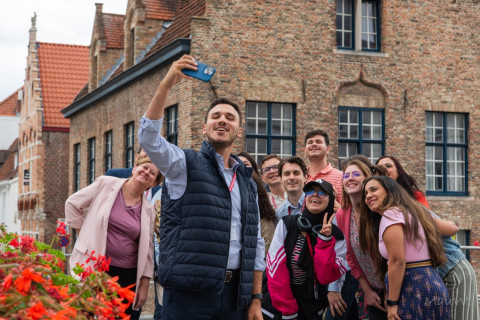
The first semester study trip offers to students a deeper understanding of European identities and a first-hand experience of policies in practice at the EU’s borders. The study trip is an integral part of the academic programme, participation is obligatory and students are expected to attend all related conferences and activities. It counts for 2 ECTS.
SECOND SEMESTER
Students following the European Security and Strategy Study Track are obligated to select a total of seven Specialist Courses. The following rules apply:
- Students select five courses from within the list of courses available to their Track.
- Students select maximum one course from the list of courses of the EHC Major.
- Students select one or two courses from the list of European Regional Studies courses.
Specialist Courses
- STODDARD, E. – Changing Character of Warfare from Antiquity to the Present Day (20h, 4 ECTS)
- MICHTA, A. - Security and Military Challenges in Europe (20h, 4 ECTS)
- TARDY, T.– L’environnement stratégique européen : évolutions et défis futurs (20h, 4 ECTS)
- POPOWSKI, M. - Building Resilience of the EU (20h, 4 ECTS)
- RILEY, A. – EU Security in an Economic Context (20h, 4 ECTS)
- GRESSEL, G. – Security and Conflict Management (20h, 4 ECTS)
- CHRISTIE, E. H. - Defence Economics and Defense Innovation (20h, 4 ECTS)
- FREYTAG VON LORINGHOVEN, A. – Challenges of Multilateralism and Intelligence Cooperation (20h, 4 ECTS)
- JERMALAVIČIUS, T. – Terrorism and Hybrid Warfare (20h, 4 ECTS)
- JANKOWSKI, D. - The Geopolitics of Technology (20h, 4 ECTS)
- KALENSKÝ, J. – The Geopolitics of Disinformation: Russia, the Neighbourhood, the Euroatlantic. What is the Threat and how to Counter it? (20h, 4 ECTS)
- HEUSER, B.– Strategy, Planning, and Foresight (20h, 4 ECTS)
- MICHAELS, J. – Nuclear Strategy (20h, 4 ECTS)
Compact Seminars
- VIMONT, P. – The EU and Crisis Management in Practice (8h, 0 ECTS)
- ZAMPIERI, F. - Maritime Geopolitics (8h, 0 ECTS)
- FRANZA, L. – Energy Security and Conflict in the EU’s Neighbourhood (10h, 0 ECTS)
- MUNOZ, R. – EU Space Policy (8h, 0 ECTS)
- CORFF, O. – China's National Security and Military Policy (8h, 0 ECTS)
- SHAGINA, M.– Sanctions and Economic Statecraft (10h, 0 ECTS)
Simulation games
Participation in the simulation games is optional.
TARDY, T. – NATO’s & the EU’s response to War in Europe (8h, 0 ECTS)
BUTTERWICK-PAWLIKOWSKI, R. – The Congress of Vienna 1814-15 (8h, 0 ECTS)
Cooperation with external partners
The Cooperation with External Partners modules are optional. There is no limit on the total number of these modules that can be taken by the students.
- MIKOS-SKUZA, E. – Introduction to International Humanitarian Law (17h, 0 ECTS)
- Workshops in history organized in cooperation with the Max Weber programme of the European University Institute (TBC, 0 ECTS)