Study track: European Interdisciplinary Studies

Academic Year 2026-2027

Why follow the European Interdisciplinary Studies study track? 

Students interested in taking a broader, cross-disciplinary view of transatlantic affairs can pursue their interests by choosing from a wide array of courses at both the College of Europe and The Fletcher School. They will gain expertise in European integration processes, EU external relations and transatlantic affairs and learn to provide imaginative solutions to today’s most pressing and complex national, regional and global challenges by adopting a multidisciplinary, interdisciplinary, contextual and multicultural approach.  

My experience in the Natolin campus has provided me with a unique perspective on transatlantic relations in Central and Eastern Europe in the midst of the Russian invasion on Ukraine.  I am confident that the knowledge and skills I am gaining in the MATA program will allow me to generate common solutions facing the EU and the US today.

- Pau Alvarez Aragones, MATA-EIS student, class of 2024


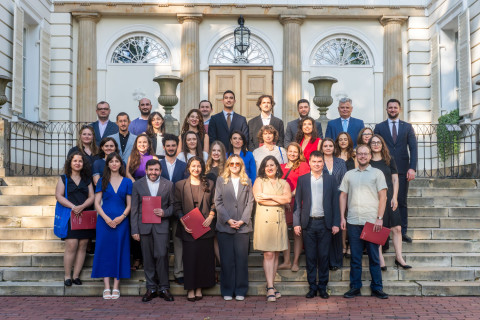
MATA-EIS Students starting at the College of Europe 


Students of the MATA programme who choose to join the “European Interdisciplinary Studies” study track (MATA-EIS) at the College of Europe will be trained to think beyond disciplinary boundaries and to understand the broader historical, regional and global context of the EU integration process and transatlantic affairs. 

In the second semester, MATA-EIS students can choose from 2 majors to gain in-depth knowledge: the EU and the World; and the EU in the Wider Europe and its Neighbours. These studies will then be complemented by coursework on international affairs at The Fletcher School.


Semester 1 (23 ECTS)

MATA-EIS students follow 15 courses during the first semester. All MATA (Y1) students at the College of Europe Bruges and Natolin campuses and The Fletcher School take the course, “US-EU Relations in the 21st Century: Multidisciplinary Analysis of Transatlantic Affairs” (5 ECTS). This course is based at The Fletcher School. 

MATA-EIS students must take all 8 EIS Introductory courses (no ECTS) and an EIS compulsory course (4 ECTS): Students will then follow 3 core courses (12 ECTS). MATA-EIS students take the Pluridisciplinary Track courses but may replace 1, 2, or all 3 courses from this track with a choice of 1, 2 or 3 courses from the Interdisciplinary Track only if they pass entry tests in the disciplines covered by the Pluridisciplinary Track. All MATA students must participate in the first-semester study trip (2 ECTS).

Students must follow some non-assessed courses: 1 (or 2) contextual courses; and at least 1 masterclass.  

The “Research Strategies and Tools” seminar and simulation games are voluntary.

During this semester, students will also start preparing their thesis proposal on transatlantic affairs as well as their internship. The primary thesis supervisor will be allocated by the EIS programme.

Compulsory MATA courses

Dimitris Skiadas 

US-EU Relations in the 21st Century : Multidisciplinary Analysis of Transatlantic Affairs

27 h.

5 ECTS

Introductory Courses

Sebastian Steingass & Amel Hammami

Introduction to Political Science

10 h.

-

Tobias Schumacher

Introduction to International Relations

10 h.

-

Peter Van Elsuwege

Introduction to Law

10 h.

-

Barbara Bobrowicz

Introduction to Economics

10 h.

-

Wolfgang Wessels

Introduction to Theories and Strategies of European Integration

10 h.

-

Rick Szostak

Introduction to Interdisciplinarity and Transdisciplinarity

10 h.

-

Edward Hunter Christie

Elementary Foundations in Economics and Econometrics

10 h.

-

Richard Butterwick-Pawlikowski

History of European Civilization

10 h.

-

Compulsory EIS course

Richard Butterwick-Pawlikowski

History of Central and Eastern Europe, 1740-1939

20h

4

Assessed core courses:

Pluridisciplinary Option

Christopher Lord

EU Institutions and Decision-making

20 h.

4 ECTS

Peter Van Elsuwege

The EU Legal Order: Rights, Norms and Values

20 h.

4 ECTS

Wolfgang Wessels

EU Economic Governance

20 h.

4 ECTS

Interdisciplinary Option

James Henderson

Energy in a Globalised World: Economics, Politics and Policies

20 h.

4 ECTS

Jean-Pierre Cassarino

International Cooperation and the Governance of Migration

20 h.

4 ECTS

Erwan Lannon

The EU Enlargement and Neighbourhood Strategies: a Geo-Legal Approach

20 h.

4 ECTS

Angelo Martelli 

Political Economy of Europe in a Changing World Order 

20 h.

4 ECTS

Study Trip:

Coordinator: Ewa Ośniecka-Tamecka; Professors: Georges Mink, Andriy Tyushka, Thomas Mayr-Harting, 

Marek Cichocki, Sławomir Dębski & Pascaline Winand

Study Trip Modules

30 h.

2 ECTS

Non-assessed contextual courses (up to 2 may be selected):

Philippe Portier

La religion dans l’Europe contemporaine

10h.

-

Anneli Kimber Lindwall

Strategic Communication in a Digital Age

8 h.

-

Ayman Mhanna

Grands enjeux de la liberté de la presse

10 h.

-

Patrycja Sasnal

Climate Induced Migration

10 h.

-

Rémi Brague

Orientalisme

10 h.

-

Ewa Krukowska

Media and Climate: Communicating the Energy Transition

8 h.

-

Marek Aleksander Cichocki and Slawomir Debski

Cold War Strategies from the Central Eastern Europe Perspective

10 h.

-

Non-assessed seminar:

Sebastian Steingass (coordinator), Barbara Bobrowicz, Natalia Chaban, Theofanis Exadaktylos, Kerry Longhurst, Georges Mink, Jason Rozumalski,  Rick 

Szostak, Peter Van Elsuwege, Matia Vannoni, Pascaline Winand


Research Strategies and Tools

20 h.

-

Non-assessed masterclass :

Edward Lucas

The Cold Wars

6h.

-


Simulation game:

Richard Butterwick-Pawlikowsk

The Paris Peace Conference of 1919-20 

10 h.

-

Vicky Marissen

EU Decision-making and Interest Representation in Practice / Le processus décisionnel de l'Union européenne et la représentation d'intérêts

10 h.

-

Semester 2 (23 ECTS)

In their second semester at the College of Europe, MATA-EIS students follow 6 courses. All MATA (Y1) students take the course, “US-EU Relations in the 21st Century: Security and Trade in Practice” (5 ECTS). 

MATA-EIS have the opportunity of specializing in 1 of 2 majors (The EU and the World or The EU in the Wider Europe and its Neighbours). They follow 4 specialist courses (16 ECTS) in their chosen major. 

Students must follow 1 (or 2) non-assessed compact seminars within their chosen major. The simulation games and activities linked Cooperation with external partners are optional.

Students also must participate in 1 of the study trips organized in the second semester (2 ECTS). In addition, all MATA students at the College of Europe participate (Bruges and Natolin) in the MATA study trip to Brussels.

Students continue to work on their thesis in transatlantic affairs and prepare their internship. At the end of their first year, students submit their thesis proposal.

Compulsory MATA courses:

Benedetta Berti & Michael Koplovsky

US-EU Relations in the 21st Century : Security and Trade in Practice” (5 ECTS)

20 h.

5 ECTS

Specialist courses for the Major, The EU and the World:

Karen E SmithThe International Relations of the EU

20h.

4 ECTS

Steven BlockmansThe Legal Dimension of EU External Relations 

 20h.

 4 ECTS

Rupert Schlegelmilch


EU Trade Policy from Rules based Trade to 

Trade Wars

 20h.

 4 ECTS

Thomas Mayr-Harting

The European Union and Bi- and Multilateral 

Diplomacy

 20h.

 4 ECTS

Youssef NassefInternational Climate Governance: Foresight and Transformative Change

20h.

4 ECTS

Pascaline WinandComparative Regionalism

20h.

4 ECTS

Patrycja SasnalHuman Rights in International Politics

20h.

4 ECTS

Jillian YorkPolitics in the Digital Age: Power, Platforms, and Participation

20h.

4 ECTS

Stefan FröhlichAfter Liberal Hegemony - Transatlantic Relations at a Crossroad

20h.

4 ECTS

Jean-Pierre CabestanChina and the World

20h.

4 ECTS 

Sandra Lavenex & Florian 

Trauner

EU Asylum and Migration Policy in Global Context

 20h.

 4 ECTS

Maurizio CarboneThe European Union, the Global South and the Politics of International Development

20 h.

4 ECTS

Thierry TardyNATO and European Defense Policy

 20h.

 4 ECTS

Compact seminars for the Major, The EU and the World:

Paul WatkinsonThe Central Role of International Cooperation in Strengthening Climate Action

10h.

-

Shada IslamThe EU and the Indo-Pacific

10h.

-

Véronique Dimier

L'Etat post-colonial en Afrique à l'épreuve des 

politiques européennes de développement

8h.

-

Gian Luca GardiniThe International Relations of Latin America and its Interaction with the EU

10h.

-

Andrea Renda (tbc)Regulation of Emerging Technologies

8h.

-

Simulation games for the Major, The EU and the World:

Richard Butterwick-PawlikowskiCreating a System of European Security: The Congress of Vienna 1814-15

10h.

-

Lukas AndriukaitisDisinformation in Diplomacy

8h.

-

Specialist courses for the Major, The EU in the Wider Europe and its Neighbours:

Tobias SchumacherWhither Neighbourhood? The EU, Eastern Europe, and the Southern Mediterranean in Times of Peace and War

20h.

4 ECTS

Adam ŁazowskiEnlargement Policy of the European Union

20h.

4 ECTS

Jean-Pierre Cassarino & Daria DavittiContested Migration Governance: Policies, Norms, and Human Rights at the Border

20h.

4 ECTS

Aron BuzoganyEU Energy Governance in the EU's Neighbourhood

 20h.

 4 ECTS

Christophe Hillion

The EU’s Relation(s) with a Wider Europe – The 

Legal Dimension

20h.

4 ECTS

Joshua Castellino & Kathleen CavanaughMinority Issues, Nationalism and Identity Politics in the EU’s Neighbourhood 

 20h.

 4 ECTS

Andriy TyushkaThe EU, Russia and the EU’s Eastern Neighbourhood: Power, Performance, and Perceptions

 20h.

 4 ECTS

Compact seminars for the Major, The EU in the Wider Europe and its Neighbours:

Natalia ChabanExternal Perceptions of the EU and EU Public Diplomacy: Views from the EU’s Neighbourhoods and around the World

10h.

-

Rana Sabbagh

Investigative Journalism in the Southern 

Neighbourhood

8h.

-

Simulation game for the Major, The EU in the Wider Europe and its Neighbours:

Richard Butterwick-PawlikowskiCreating a System of European Security: The Congress of Vienna 1814-15

10h.

-

Luca FranzaEnergy and Climate in the Neighbourhood

8h.

-

Study Trip:

Coordinator: Ewa Ośniecka-Tamecka; Professors: Georges Mink, Andriy Tyushka, Thomas Mayr-Harting, Pascaline Winand, Adam 

Łazowski & Patrycja Sasnal

Study Trip Modules

30 h.

2 ECTS

Voluntary courses for all majors : Cooperation with external partners

Elzbieta Mikos-SkuzaIntroduction to International Humanitarian Law within the framework of a seminar organized with the International Committee of the Red Cross - open to external participants 

 17h. 

-

 Workshops in history organized in cooperation with the Max Weber programme of the European University Institute-

-


For semester 3 and 4, students can choose between 3 options.


Option 1:

Semester 3 (24 ECTS)

At The Fletcher School, MATA-EIS students will select 4 courses (6 ECTS each and between 26.5h and 32.5h each), primarily from the Diplomacy, History and Politics (DHP) and International Law and Organization (ILO) and Economics and International Business (EIB) divisions. They may also cross-register and substitute 1 of these 4 courses by a relevant course from Tufts University or Harvard University. If a student has not already made arrangements with a member of the Fletcher faculty to be their second thesis supervisor, one will be assigned.

Semester 4 (50 ECTS)

Students will carry out a high-level internship (25 ECTS) related to transatlantic affairs of ideally 4 months, but at least 3 months. Students who start the MATA programme at the College of Europe are encouraged to do their internship in the United States.

In late March, MATA students will hand in their Master’s thesis (25 ECTS) on a topic of transatlantic affairs and the thesis defense will be in April. 


Option 2:

Semester 3 (25 ECTS)

Students will carry out a high-level internship (25 ECTS) related to transatlantic affairs of ideally 4 months, but at least 3 months. Students who start the MATA programme at the College of Europe are encouraged to do their internship in the United States.

If a student has not already made arrangements with a member of the Fletcher faculty to be their second thesis supervisor, one will be assigned.

Semester 4 (49 ECTS)

At The Fletcher School, MATA-EIS students will select 4 courses (6 ECTS each and between 26.5h and 32.5h each). They may also cross-register and substitute 1 of these 4 courses by a relevant course from Tufts University or Harvard University. 

In late March, MATA students will hand in their Master’s thesis (25 ECTS) on a topic of transatlantic affairs and the thesis defense will be in April. 


Option 3:

Semester 3 (24.5 ECTS)

At The Fletcher School, MATA-EIS students will select 4 courses (6 ECTS and between 26.5h and 32.5h each) from any of the 3 divisions: International Law and Organizations (ILO); Diplomacy, History and Politics (DHP); and Economics and International Business (EIB). They may also cross-register and substitute 1 of these 4 courses by a relevant course from Tufts University or Harvard University. In addition, MATA students must take a half-credit course (0.5 ECTS).

If a student has not already made arrangements with a member of the Fletcher faculty to be their second thesis supervisor, one will be assigned during the third semester. During this semester, students will continue to work on their thesis, with 1 mandatory exchange with their primary thesis supervisor at the College of Europe


Semester 4 (49.5 ECTS)

At The Fletcher School, MATA-EIS students will select 4 courses (6 ECTS each and between 26.5h and 32.5h each). They may also cross-register and substitute 1 of these 4 courses by a relevant course from Tufts University or Harvard University. In addition, MATA students must take a half-credit course (0.5 ECTS).

In late March, MATA students will hand in their Master’s thesis (25 ECTS) on a topic of transatlantic affairs and the thesis defense will be in April. 


MATA-EIS Students starting at the Fletcher School

Students of the MATA programme who choose to spend their first year of studies at The Fletcher School will focus to a larger extent on international relations and slightly less on the European dimension of interdisciplinary studies than those students who begin their studies at the College of Europe.

During the 2 semesters at The Fletcher School, students must choose at least 1 course from each of the 3 divisions (‘breadth requirement’): International Law and Organizations (ILO); Diplomacy, History and Politics (DHP); and Economics and International Business (EIB). 


Semester 1 (23 ECTS)

At The Fletcher School, MATA-EIS students will follow 4 courses during the first semester. 

All MATA (Y1) students at the College of Europe Bruges and Natolin campuses and The Fletcher School take the course, “US-EU Relations in the 21st Century: Multidisciplinary Analysis of Transatlantic Affairs” (5 ECTS). This course is based at The Fletcher School. 

Additionally, students choose 3 courses offered at The Fletcher School (18 ECTS). They may also cross-register and substitute 1 of them by a relevant course from Tufts University or Harvard University.

Compulsory MATA course

Dimitris Skiadas

US-EU Relations in the 21st Century : Multidisciplinary Analysis of Transatlantic Affairs

27 h.

5 ECTS

Elective courses at The Fletcher School:

Students choose 3 other courses (6 ECTS each and between 26.5h and 32.5h each), taking into account the ‘breadth requirement’.

During this semester, students will also start preparing their thesis proposal on transatlantic affairs and their internship with a primary thesis supervisor assigned by The Fletcher School. 


Semester 2 (29 ECTS)

At The Fletcher School, MATA-EIS students will follow 5 courses during the second semester. 

In their second semester, all MATA (Y1) students take the course, “US-EU Relations in the 21st Century: Security and Trade in Practice” (5 ECTS)” (5 ECTS). 

Additionally, they choose 4 courses offered at The Fletcher School (24 ECTS). They may also cross-register and substitute 1 of them by a relevant course from Tufts University or Harvard University.

MATA Compulsory course:

Benedetta Berti & Michael Koplovsky

US-EU Relations in the 21st Century : Security and Trade in Practice” (5 ECTS)

20 h.

5 ECTS

Elective courses:

Students choose to follow 4 other courses (6 ECTS each and between 26.5h and 32.5h each), taking into account the ‘breadth requirement’.

Students will continue to work on their thesis in transatlantic affairs and prepare their internship. At the end of their first year, students submit their thesis proposal.


Semester 3 (25 ECTS)

Students will carry out a high-level internship (25 ECTS) related to transatlantic affairs of ideally 4 months, but at minimum 3 months. Students who start the MATA programme at The Fletcher School are strongly encouraged to do their internship in Europe.


Semester 4 (43 ECTS)

MATA-EIS students take 5 courses during the 4th semester. 

MATA-EIS students also follow 4 specialist courses (16 ECTS) within the major of The EU in the World or The EU in Wider Europe and its Neighbours. 

Students must follow 1 (or 2) non-assessed compact seminars within their chosen major. Simulation games and activities linked with Cooperation with external partners are optional.

Students participate in 1 of the study trips organized during this semester (2 ECTS, 30h). In addition, all MATA students at the College of Europe participate in the MATA study trip to Brussels.

In late March, students submit their Master’s thesis (25 ECTS) on a topic of transatlantic affairs with a defence in April. 

Specialist courses for the Major, The EU and the World:

Karen E SmithThe International Relations of the EU

20h.

4 ECTS

Steven BlockmansThe Legal Dimension of EU External Relations 

 20h.

 4 ECTS

Rupert Schlegelmilch


EU Trade Policy from Rules based Trade to 

Trade Wars

 20h.

 4 ECTS

Thomas Mayr-Harting

The European Union and Bi- and Multilateral 

Diplomacy

 20h.

 4 ECTS

Youssef NassefInternational Climate Governance: Foresight and Transformative Change

20h.

4 ECTS

Pascaline WinandComparative Regionalism

20h.

4 ECTS

Patrycja SasnalHuman Rights in International Politics

20h.

4 ECTS

Jillian YorkPolitics in the Digital Age: Power, Platforms, and Participation

20h.

4 ECTS

Stefan FröhlichAfter Liberal Hegemony - Transatlantic Relations at a Crossroad 

20h.

4 ECTS

Jean-Pierre CabestanChina and the World

20h.

4 ECTS 

Sandra Lavenex & Florian 

Trauner

EU Asylum and Migration Policy in Global Context

 20h.

 4 ECTS

Maurizio CarboneThe European Union, the Global South and the Politics of International Development

20 h.

4 ECTS

Thierry TardyNATO and European Defense Policy

 20h.

 4 ECTS

Compact seminars for the Major, The EU and the World:

Paul WatkinsonThe Central Role of International Cooperation in Strengthening Climate Action

10h.

-

Shada IslamThe EU and the Indo-Pacific

10h.

-

Véronique Dimier

L'Etat post-colonial en Afrique à l'épreuve des 

politiques européennes de développement

8h.

-

Gian Luca GardiniThe International Relations of Latin America and its Interaction with the EU

10h.

-

Andrea Renda (tbc)Regulation of Emerging Technologies

8h.

-

Simulation games for the Major, The EU and the World:

Richard Butterwick-PawlikowskiCreating a System of European Security: The Congress of Vienna 1814-15

10h.

-

Lukas AndriukaitisDisinformation in Diplomacy

8h.

-

Specialist courses for the Major, The EU in the Wider Europe and its Neighbours:

Tobias SchumacherWhither Neighbourhood? The EU, Eastern Europe, and the Southern Mediterranean in Times of Peace and War

20h.

4 ECTS

Adam ŁazowskiEnlargement Policy of the European Union

20h.

4 ECTS

Jean-Pierre Cassarino & Daria DavittiContested Migration Governance: Policies, Norms, and Human Rights at the Border

20h.

4 ECTS

Aron BuzoganyEU Energy Governance in the EU's Neighbourhood

 20h.

 4 ECTS

Christophe Hillion

The EU’s Relation(s) with a Wider Europe – The 

Legal Dimension

20h.

4 ECTS

Joshua Castellino & Kathleen CavanaughMinority Issues, Nationalism and Identity Politics in the EU’s Neighbourhood 

 20h.

 4 ECTS

Andriy TyushkaThe EU, Russia and the EU’s Eastern Neighbourhood: Power, Performance, and Perceptions

 20h.

 4 ECTS

Compact seminars for the Major, The EU in the Wider Europe and its Neighbours:

Natalia ChabanExternal Perceptions of the EU and EU Public Diplomacy: Views from the EU’s Neighbourhoods and around the World

10h.

-

Rana Sabbagh

Investigative Journalism in the Southern 

Neighbourhood

8h.

-

Simulation game for the Major The EU in the Wider Europe and its Neighbours:

Richard Butterwick-PawlikowskiCreating a System of European Security: The Congress of Vienna 1814-15

10h.

-

Luca FranzaEnergy and Climate in the Neighbourhood

8h.

-

Study Trip:

Coordinator: Ewa Ośniecka-Tamecka; Professors: Georges Mink, Andriy Tyushka, Thomas Mayr-Harting, Pascaline Winand, Adam 

Łazowski & Patrycja Sasnal

Study Trip Modules

30 h.

2 ECTS

Voluntary courses for all majors : Cooperation with external partners

MIKOS-SKUZA E.Introduction to International Humanitarian Law within the framework of a seminar organized with the International Committee of the Red Cross- open to external participants 

 17h. 

-

 Workshops in history organized in cooperation with the Max Weber programme of the European University Institute-

-


“European Security and Strategy Study Track"

MATA-ESSST Students starting at the College of Europe 

Students of the MATA programme who choose to join the “European Security and Strategy Study Track (MATA-ESSST) at the College of Europe will focus on security elements of the transatlantic relationship in addition to broader security concerns for Europe.

Semester 1 (23 ECTS)

MATA-ESST students follow 15 courses during the first semester. All MATA (Y1) students at the College of Europe Bruges and Natolin campuses and The Fletcher School take the course, “US-EU Relations in the 21st Century: Multidisciplinary Analysis of Transatlantic Affairs” (5 ECTS). This course is based at The Fletcher School. 

MATA-ESSST students must take all 8 Introductory courses (no ECTS) and an ESSST compulsory course (4 ECTS): Students will then follow 3 core courses (12 ECTS)All MATA students must participate in the first-semester study trip (2 ECTS).

Students must follow 1 (or 2) contextual courses, and at least 1 masterclass. 

The “Research Strategies and Tools” seminar and simulation games are voluntary.

During this semester, students will also start preparing their thesis proposal on transatlantic affairs as well as their internship. The primary thesis supervisor will be allocated by the ESSST programme.

Compulsory MATA courses

Dimitris Skiadas 

US-EU Relations in the 21st Century : Multidisciplinary Analysis of Transatlantic Affairs

27 h.

5 ECTS

Introductory Courses

Sebastian Steingass & Amel Hammami

Introduction to Political Science

10 h.

-

Tobias Schumacher

Introduction to International Relations

10 h.

-

Peter Van Elsuwege

Introduction to Law

10 h.

-

Barbara Bobrowicz

Introduction to Economics

10 h.

-

Wolfgang Wessels

Introduction to Theories and Strategies of European Integration

10 h.

-

Rick Szostak

Introduction to Interdisciplinarity and Transdisciplinarity

10 h.

-

Edward Hunter Christie

Elementary Foundations in Economics and Econometrics

10 h.

-

Richard Butterwick-Pawlikowski

History of European Civilization

10 h.

-

Compulsory course

Richard Butterwick-Pawlikowski

History of Central and Eastern Europe, 1740-1939

20h

4

Assessed core courses:

Stefan  Auer

The Sources of EU Power in Times of War

20 h.

4 ECTS

Luiza Bialasiewicz

Geo-politics

20 h.

4 ECTS

Beatrice Heuser 

Theories of War and Dimensions of Strategy

20 h.

4 ECTS

Non-assessed (up to 2 may be selected):

Marek Belka

State and Economy

10 h.

-

Lukas Milesvski

Making Sense of Military Strategy

8 h.

-

Dieter Schlenker

External Relations, Security and Defence through the Prism of EU Historical Documents

10 h.

-

Antonino Ali

The Use of Force in International Law

10 h.

-

Fadi Daou

Ethics and Religion in Armed Conflicts

10 h.

-

Eliot Cohen

Strategy in Theory and Practice

8 h.

-

Marek Aleksander Cichocki and Slawomir Debski

Cold War Strategies from the Central Eastern Europe Perspective

10 h.

-

Non-assessed masterclass:

Oana Lungescu

Communicating Security

6h.

-

Rajmund Andrzejczak

Military Security

8h.

-

Non-assessed seminar:

Sebastian Steingass (coordinator), Barbara Bobrowicz, Natalia Chaban, Theofanis Exadaktylos, Kerry Longhurst, Georges Mink, Jason Rozumalski,  Rick 

Szostak, Peter Van Elsuwege, Matia Vannoni, Pascaline Winand


Research Strategies and Tools

20 h.

-

Simulation game:

Georges Mink & Marek Aleksander Cichocki

Drafting a Peace Treaty for the End of the Cold War 

10 h.

-

Tobias Schumacher

EU Foreign Policy-Making in Times of Conflict in the EU's Neighbourhood

10 h.

-

Study Trip:

Coordinator: Ewa Ośniecka-Tamecka; Professors: Georges Mink, Andriy Tyushka, Thomas Mayr-Harting, 

Marek Cichocki, Sławomir Dębski & Pascaline Winand

Study Trip Modules

30 h.

2 ECTS

Semester 2 (23 ECTS)

In their second semester at the College of Europe, MATA-ESSST students follow 6 courses. All MATA (Y1) students take the course, “US-EU Relations in the 21st Century: Security and Trade in Practice” (5 ECTS). 

MATA-ESSST follow 4 specialist courses (16 ECTS) and 1 (or 2) non-assessed compact seminars. The simulation games and activities linked Cooperation with external partners are optional.

Students also must participate in 1 of the study trips organized in the second semester (2 ECTS). In addition, all MATA students at the College of Europe participate (Bruges and Natolin) in the MATA study trip to Brussels.

Students continue to work on their thesis in transatlantic affairs and prepare their internship. At the end of their first year, students submit their thesis proposal.


Compulsory MATA courses:

Benedetta Berti & Michael Koplovsky

US-EU Relations in the 21st Century : Security and Trade in Practice” (5 ECTS)

20 h.

5 ECTS

Specialist courses:

Gustav GresselSecurity and Conflict Management

 20h. 

 4 ECTS

Edward StoddardChanging Character of Warfare from Antiquity to the Present Day

 20h. 

 4 ECTS

Beatrice HeuserStrategy, Planning and Foresight

 20h. 

 4 ECTS

Andrew MichtaSecurity and Military Challenges in Europe

 20h. 

 4 ECTS

Thierry TardyL’environnement Stratégique européen : évolutions et défis futurs

 20h. 

 4 ECTS

Maciej PopowskiBuilding Resilience of the EU

 20h. 

 4 ECTS

Alan RileyEU Security in an Economic Context

 20h. 

 4 ECTS

Edward Hunter ChristieDefence Economics and Defence Innovation

 20h. 

 4 ECTS

Arndt Freytag von LoringhovenChallenges of Multilateralism and Intelligence Cooperation

 20h. 

 4 ECTS

Jeffrey MichaelsNuclear Strategy

 20h. 

 4 ECTS

Tomas JermalavičiusTerrorism and Hybrid Warfare

 20h. 

 4 ECTS

Dominik JankowskiThe Geopolitics of Technology

 20h. 

 4 ECTS

Jakub KalenskyThe Geopolitics of Disinformation: Russia, the Neighbourhoods, the Euroatlantic. What is the Threat and how to Counter it?

 20h. 

 4 ECTS

Compact seminars:

Pierre VimontThe EU and Crisis Management in Practice

8h.

-

Rodolphe MunozEU Space Policy

8h.

-

Francesco ZampieriMaritime Geopolitics

8h.

-

Luca FranzaEnergy Security and Conflict in the EU’s Neighbourhood

10h.

-

Olivier CorffChina’s National Security and Military Policy

8h.

-

Maria ShaginaSanctions and Economic Statecraft

10h.

-

Simulation game for the ESSST :

Richard Butterwick-PawlikowskiCreating a System of European Security: The Congress of Vienna 1814-15

10h.

-

Thierry TardyNATO and the EU’s Response to War in Europe

8h.

-

Study Trip:

Coordinator: Ewa Ośniecka-Tamecka; Professors: Georges Mink, Andriy Tyushka, Thomas Mayr-Harting, Pascaline Winand, Adam 

Łazowski & Patrycja Sasnal

Study Trip Modules

30 h.

2 ECTS

Voluntary courses : Cooperation with external partners

Elzbieta Mikos-SkuzaIntroduction to International Humanitarian Law within the framework of a seminar organized with the International Committee of the Red Cross - open to external participants 

 17h. 

-

 Workshops in history organized in cooperation with the Max Weber programme of the European University Institute-

-


For semester 3 and 4, students can choose between 3 options.


Option 1:

Semester 3 (24 ECTS)

At The Fletcher School, MATA-ESSST students will select 4 courses (6 ECTS each and between 26.5h and 32.5h each), primarily from the Diplomacy, History and Politics (DHP) and International Law and Organization (ILO) and Economics and International Business (EIB) divisions. They may also cross-register and substitute 1 of these 4 courses by a relevant course from Tufts University or Harvard University. If a student has not already made arrangements with a member of the Fletcher faculty to be their second thesis supervisor, one will be assigned.

Semester 4 (50 ECTS)

Students will carry out a high-level internship (25 ECTS) related to transatlantic affairs of ideally 4 months, but at least 3 months. Students who start the MATA programme at the College of Europe are encouraged to do their internship in the United States.

In late March, MATA students will hand in their Master’s thesis (25 ECTS) on a topic of transatlantic affairs and the thesis defense will be in April. 


Option 2:

Semester 3 (25 ECTS)

Students will carry out a high-level internship (25 ECTS) related to transatlantic affairs of ideally 4 months, but at least 3 months. Students who start the MATA programme at the College of Europe are encouraged to do their internship in the United States.

If a student has not already made arrangements with a member of the Fletcher faculty to be their second thesis supervisor, one will be assigned.

Semester 4 (49 ECTS)

At The Fletcher School, MATA-ESSST students will select 4 courses (6 ECTS each and between 26.5h and 32.5h each). They may also cross-register and substitute 1 of these 4 courses by a relevant course from Tufts University or Harvard University. 

In late March, MATA students will hand in their Master’s thesis (25 ECTS) on a topic of transatlantic affairs and the thesis defense will be in April. 


Option 3:

Semesters 3 and 4 (74 ECTS)

Option 3:

Semester 3 (24.5 ECTS)

At The Fletcher School, MATA-ESSST students will select 4 courses (6 ECTS and between 26.5h and 32.5h each) from any of the 3 divisions: International Law and Organizations (ILO); Diplomacy, History and Politics (DHP); and Economics and International Business (EIB). They may also cross-register and substitute 1 of these 4 courses by a relevant course from Tufts University or Harvard University. In addition, MATA students must take a half-credit course (0.5 ECTS).

If a student has not already made arrangements with a member of the Fletcher faculty to be their second thesis supervisor, one will be assigned during the third semester. During this semester, students will continue to work on their thesis, with 1 mandatory exchange with their primary thesis supervisor at the College of Europe


Semester 4 (49.5 ECTS)

At The Fletcher School, MATA-ESSST students will select 4 courses (6 ECTS each and between 26.5h and 32.5h each). They may also cross-register and substitute 1 of these 4 courses by a relevant course from Tufts University or Harvard University. In addition, MATA students must take a half-credit course (0.5 ECTS).

In late March, MATA students will hand in their Master’s thesis (25 ECTS) on a topic of transatlantic affairs and the thesis defense will be in April. 


MATA-ESSST Students starting at the Fletcher School

Students of the MATA programme who choose to spend their first year of studies at The Fletcher School will focus to a larger extent on international relations and slightly less on the European dimension of interdisciplinary studies than those students who begin their studies at the College of Europe.

During the 2 semesters at The Fletcher School, students must choose at least 1 course from each of the 3 divisions (‘breadth requirement’): International Law and Organizations (ILO); Diplomacy, History and Politics (DHP); and Economics and International Business (EIB). 

Semester 1 (23 ECTS)

At The Fletcher School, MATA-ESSST students will follow 4 courses during the first semester. 

All MATA (Y1) students at the College of Europe Bruges and Natolin campuses and The Fletcher School take the course, “US-EU Relations in the 21st Century: Multidisciplinary Analysis of Transatlantic Affairs” (5 ECTS). This course is based at The Fletcher School. 

Additionally, students choose 3 courses offered at The Fletcher School (18 ECTS). They may also cross-register and substitute 1 of them by a relevant course from Tufts University or Harvard University.

Compulsory MATA course

Dimitris Skiadas

US-EU Relations in the 21st Century : Multidisciplinary Analysis of Transatlantic Affairs

27 h.

5 ECTS

Elective courses at The Fletcher School:

Students choose 3 other courses (6 ECTS each and between 26.5h and 32.5h each), taking into account the ‘breadth requirement’.

During this semester, students will also start preparing their thesis proposal on transatlantic affairs and their internship with a primary thesis supervisor assigned by The Fletcher School. 

Semester 2 (29 ECTS)

At The Fletcher School, MATA-ESSST students will follow 5 courses during the second semester. 

In their second semester, all MATA (Y1) students take the course, “US-EU Relations in the 21st Century: Security and Trade in Practice” (5 ECTS)” (5 ECTS). 

Additionally, they choose 4 courses offered at The Fletcher School (24 ECTS). They may also cross-register and substitute 1 of them by a relevant course from Tufts University or Harvard University.

MATA Compulsory course:

Benedetta Berti & Michael Koplovsky

US-EU Relations in the 21st Century : Security and Trade in Practice” (5 ECTS)

20 h.

5 ECTS

Elective courses:

Students choose to follow 4 other courses (6 ECTS each and between 26.5h and 32.5h each), taking into account the ‘breadth requirement’.

Students will continue to work on their thesis in transatlantic affairs and prepare their internship. At the end of their first year, students submit their thesis proposal.

Semester 3 (25 ECTS)

Students will carry out a high-level internship (25 ECTS) related to transatlantic affairs of ideally 4 months, but at minimum 3 months. Students who start the MATA programme at The Fletcher School are strongly encouraged to do their internship in Europe.

Semester 4 (43 ECTS)

MATA-ESSST students take 5 courses during the 4th semester. 

Students follow 4 specialist courses and 1 (or 2) non-assessed compact seminars. Simulation games and activities linked with Cooperation with external partners are optional.

Students participate in 1 of the study trips organized during this semester (2 ECTS, 30h). In addition, all MATA students at the College of Europe participate in the MATA study trip to Brussels.

In late March, students submit their Master’s thesis (25 ECTS) on a topic of transatlantic affairs with a defence in April. 

Specialist courses:

Gustav GresselSecurity and Conflict Management

 20h. 

 4 ECTS

Edward StoddardChanging Character of Warfare from Antiquity to the Present Day

 20h. 

 4 ECTS

Beatrice HeuserStrategy, Planning and Foresight

 20h. 

 4 ECTS

Andrew MichtaSecurity and Military Challenges in Europe

 20h. 

 4 ECTS

Thierry TardyL’environnement Stratégique européen : évolutions et défis futurs

 20h. 

 4 ECTS

Maciej PopowskiBuilding Resilience of the EU

 20h. 

 4 ECTS

Alan RileyEU Security in an Economic Context

 20h. 

 4 ECTS

Edward Hunter ChristieDefence Economics and Defence Innovation

 20h. 

 4 ECTS

Arndt Freytag von LoringhovenChallenges of Multilateralism and Intelligence Cooperation

 20h. 

 4 ECTS

Jeffrey MichaelsNuclear Strategy

 20h. 

 4 ECTS

Tomas JermalavičiusTerrorism and Hybrid Warfare

 20h. 

 4 ECTS

Dominik JankowskiThe Geopolitics of Technology

 20h. 

 4 ECTS

Jakub KalenskyThe Geopolitics of Disinformation: Russia, the Neighbourhoods, the Euroatlantic. What is the Threat and how to Counter it?

 20h. 

 4 ECTS

Compact seminars:

Pierre VimontThe EU and Crisis Management in Practice

8h.

-

Rodolphe MunozEU Space Policy

8h.

-

Francesco ZampieriMaritime Geopolitics

8h.

-

Luca FranzaEnergy Security and Conflict in the EU’s Neighbourhood

10h.

-

Olivier CorffChina’s National Security and Military Policy

8h.

-

Maria ShaginaSanctions and Economic Statecraft

10h.

-

Simulation game for the ESSST :

Richard Butterwick-PawlikowskiCreating a System of European Security: The Congress of Vienna 1814-15

10h.

-

Thierry TardyNATO and the EU’s Response to War in Europe

8h.

-

Study Trip:

Coordinator: Ewa Ośniecka-Tamecka; Professors: Georges Mink, Andriy Tyushka, Thomas Mayr-Harting, Pascaline Winand, Adam 

Łazowski & Patrycja Sasnal

Study Trip Modules

30 h.

2 ECTS


Voluntary courses : Cooperation with external partners

Elzbieta Mikos-SkuzaIntroduction to International Humanitarian Law within the framework of a seminar organized with the International Committee of the Red Cross - open to external participants 

 17h. 

-

 Workshops in history organized in cooperation with the Max Weber programme of the European University Institute-

-


Thesis submission (25 ECTS) in late March and defence in April