Understand how Europe makes decisions—and how those decisions shape transatlantic affairs
The European Politics and Governance track combines an in-depth understanding of the European Union’s institutions, political processes and policy priorities with the broader study of governance and international affairs at The Fletcher School.
During your first year in Bruges, you will examine the political, economic and legal foundations of European integration, explore how EU institutions negotiate and implement policy, and specialise in the policy areas most relevant to your interests. At Fletcher, you can broaden that European perspective through coursework in international law, diplomacy and politics, economics and international business.
Bruges + Fletcher · EU institutions and policymaking · Negotiation simulation · Brussels and Strasbourg study trips · Internship and thesis

MATA-POL students work with their European Political and Governance Studies peers to prepare a presentation for regional officials at the European Collectivity of Alsace during the Strasbourg study trip.
[Explore the curriculum]
[Compare the second-year routes]
Why choose European Politics and Governance?
Understand how the EU works
Develop detailed knowledge of the EU’s institutions, political system and policymaking processes. Examine both formal decision-making procedures and the informal relationships through which European policies are negotiated and implemented.
Connect institutions with policy
Explore how institutional structures affect policy choices in areas such as the economy, climate, technology, migration, social affairs, security, foreign policy and enlargement.
Learn through negotiation and simulation
Apply your knowledge through an intensive simulation of EU negotiation and decision-making. Develop practical skills in representing interests, coalition-building, communication and reaching agreement.
Develop your own specialisation
Choose elective courses from four broad areas: EU internal policies, European governance, the EU and its Member States, and Europe’s role in the world.
Add a transatlantic perspective
Complement your European specialisation through the common MATA course, study at Fletcher, a transatlantic internship and a thesis drawing on the academic resources of both institutions.
What will you learn?
The track combines MATA’s programme-wide learning outcomes with detailed knowledge of European politics, institutions and public policy. By completing the track, you will learn to:
Analyse European institutions and policymaking
Understand the respective roles of the EU institutions, bodies and Member States, as well as the political, legal and economic foundations of their decisions.
Examine governance from multiple perspectives
Assess how political actors, administrations, interest groups, civil society and citizens shape EU policies and institutional change.
Connect domestic, European and global politics
Analyse how national political pressures influence EU decision-making and how the EU responds to transatlantic and global challenges.
Evaluate policy choices
Use evidence from different disciplines to assess policy options in fields such as climate, finance, technology, migration, security and social affairs.
Negotiate and communicate
Develop clear, evidence-based positions; represent institutional interests; communicate with different audiences; and work toward agreement in complex political settings.
Work across institutions and cultures
Strengthen the professional autonomy, organisational ability and intercultural competence needed to work in European, international and transatlantic environments.
[View the full MATA intended learning outcomes]
Your first year in Bruges
Semester 1: Institutions and foundations
Build a strong foundation in the political economy of European integration, EU governance and policymaking, and US–EU relations.
You will also choose courses examining specific European institutions and bodies. Options currently include the European Parliament, Council, Commission, European Council, Court of Justice and EU agencies.
[View Semester 1 courses and ECTS]
MATA-POL students will follow 7 courses during the first semester.
They also take 5 compulsory POL courses: all follow “The Political Economy of European Integration” and “Governance, Politics and Policy-Making of the EU”. MATA-POL students select 3 of the following 6-hour compulsory courses: “Public Integrity and Ethics in the EU”; “Rise of Populism, Political Polarization and Fragmentation Across Europe”; ” Future of Europe – Views from the Capitals”; “The Consensus Machine: Formal and Informal Interinstitutional Cooperation in the EU”; and “EU security and defence: a new kind of geopolitical actor? Responding to traditional threats and new security challenges”.
Each student chooses 1 elective on EU Institutions, Bodies and Administration These courses are designed to familiarise students with the political and economic rationale for European integration and introduce them to the EU’s main institutions and policy areas.
MATA-POL students may voluntarily take “Research Design & Methods in Governance, Politics and Policy-Making of the EU” (no ECTS).
MATA compulsory courses:
- SKIADAS Dimitris - US-EU Relations in the 21st Century : Multidisciplinary Analysis of Transatlantic Affairs - 5 ECTS
POL compulsory courses
- CHANG Michele - The Political Economy of European Integration - 6 ECTS
- KAEDING Michael - Governance, Politics and Policy-Making of the EU - 4 ECTS
Students select 3:
- ALEMANNO Alberto - Public Integrity and Ethics in the EU* - 1 ECTS
- DE VRIES Catherine - Rise of Populism, Political Polarization and Fragmentation Across Europe* - 1 ECTS
- KAEDING Michael - Future of Europe – Views from the Capitals* - 1 ECTS
- KURPAS Sebastian - The Consensus Machine: Formal and Informal Interinstitutional Cooperation in the EU* - 1 ECTS
- WESTON Alison - EU security and defence: a new kind of geopolitical actor? Responding to traditional threats and new security challenges* -1 ECTS
*For this course no mark is attributed but full attendance is compulsory and any absence has to be compensated by a paper assignment. If a student fails, a mark will be attributed and mentioned on the transcript (coefficient 1) and will be taken into consideration in the calculation of a possible compensation.
- Each student also chooses 1 elective on EU Institutions, Bodies and Administration among:
- KAEDING Michael - The Role of EU Agencies as Policy Entrepreneurs in Decentralizing EU Governance - 4 ECTS
- LEHMANN Wilhelm & RIPOLL SERVENT Ariadna - The European Parliament in the EU’s Political System - 4 ECTS
- PUETTER Uwe - The Council of the EU - Inside the EU’s Negotiation Machine - 4 ECTS
- SAURUGGER Sabine and TERPAN Fabien - The Court of Justice of the European Union as a Policy Actor - 4 ECTS
- SZAPIRO Manuel - La Commission européenne en pers/pros-pective : Métiers, Mutations, Réformes - 4 ECTS
- WESSELS Wolfgang & SCHRAMM Lucas - The European Council: A Real World Analysis of the Leaders’ Institution - 4 ECTS
Voluntary seminar in research design (no ECTS)
TOSHKOV Dimitir - Research Design & Methods in Governance, Politics and Policy-Making of the EU
Students may follow any of the non-assessed Workshops in Professional Development (6h) and they may apply to participate in any of the extracurricular activities offered by the European Political and Governance Studies Department.
During this semester, students will also start preparing their thesis proposal on transatlantic affairs as well as their internship. The primary thesis supervisor will be allocated by the POL department.
Semester 2: Policy choice and political practice
Apply your institutional knowledge through the European Politics and Governance negotiation simulation and the practice-oriented MATA course.
Choose electives from four thematic areas and continue developing your thesis and internship plans.
[View Semester 2 courses and ECTS]
In their second semester at the College of Europe, MATA-POL students follow 5 courses. All MATA (Y1) students take the course, “US-EU Relations in the 21st Century: Security and Trade in Practice” (5 ECTS). In the second semester, this course is focused on practical exercises.
Students must take 1 POL compulsory course: “Negotiation and Decision-Making in the EU: A Simulation Game”.
For their electives, students chose 3 optional courses.
In addition to the POL study trip to Strasbourg, all MATA students at the College of Europe participate in the MATA study trip to Brussels.
Students will continue to work on their thesis in transatlantic affairs and prepare their internship. At the end of their first year, students submit their thesis proposal.
MATA compulsory courses:
- BERTI Benedetta & KOVLOVSKY Michael - US-EU Relations in the 21st Century: Security and Trade in Practice - 5 ECTS
POL compulsory courses:
- HERMANIN Constanza, RIBO LABASTIDA Alejandro & SETTEMBRI Pierpaolo - Negotiation and Decision-Making in the EU: A Simulation Game
Optional courses
Each student chooses 3 optional courses from 4 different clusters. Each course counts for 4 ECTS.
Cluster: EU Internal Policies
BEIRENS Hanne - Managing Migration in Europe: Taking Stock of the Legal Tools, Best Practices and Practical Challenges in the Field of Migration and Asylum - 4 ECTS
- MUNOZ Rodolphe & BERNARD Elsa - Le marché intérieur face aux défis du 21éme siècle : libre échange, compétitivité et protection face à la montée des replis nationaux. - 5 ECTS
BUSCHLE Dirk and NIES Susanne - The Green Deal – Unpacking the EU´s Energy and Climate Policies - 4 ECTS
CHANG Michele & GLÖCKLER Gabriel - Financing the EU’s Geopolitical Ambitions and Economic Transformations: EU Fiscal, Financial, and Monetary Policies - 4 ECTS
CRESPY Amandine - The EU and the Fight Against Social Inequality - 5 ECTS
DELREUX Tom - Governing the green transition: EU environment and climate policy - 4 ECTS
LORENZANI Dimitri - Foresight, Industrial Strategy, and Digital Policies: a New ‘Consistent Trio’ in the EU - 4 ECTS
PETERS Eric & KLEINER Thibaut - Les politiques numériques dans l’Union européenne - 4 ECTS
Cluster: European Governance
COEN David & KATSAITIS Alexander - Interest Representation in the EU - 4 ECTS
HODSON Dermot & WESTLAKE Martin - Politics, People and Power: Personalities and European Integration - 4 ECTS
HÖGENAUER Anna-Lena & MIšIK Matúš - Influence without the numbers? Challenges and Strategies of Small-to-Medium-Sized States in the EU institutions and policies - 4 ECTS
LEFKOFRIDI Zoe & CERON Matilde - Gender and Power in the EU: Theory, Policy Practice and Future Challenges - 4 ECTS
SCHIMMELFENNIG Frank - Differentiated Integration and the Future of Europe: Preparing the EU for Geopolitical Change, Enlargement and Policy Reform - 4 ECTS
VITREY de GARDEBOSC Anne - Les finances publiques de l’Union européenne -4 ECTS
Cluster: EU and the Member States
EYMERI-DOUZANS Jean-Michel - Comprendre la mise en œuvre différenciée des politiques européennes sur le terrain. Analyse comparée d’une Union d’États membres - 4 ECTS
KASSIM Hussein - Bringing the member states back in: national narratives, domestic politics, national institutions and the EU - 4 ECTS
- LOPRIORE Marco & TINELLI Cristina - EU Agriculture and Cohesion Policy After 2028: A Radical Shift or Revision? - 4 ECTS
VAN INGELGOM Virginie - Les opinions et attitudes des citoyens et citoyennes et de la société civile dans l'UE : une approche comparative -4 ECTS
Cluster: Europe and the World
ANGHEL Veronica & JONES Erik - Beyond Borders: EU Enlargement and Europe’s Geopolitical Turn - 4 ECTS
GREVI Giovanni & GÜRKAN Seda - Shifting Global Order: The EU’s Foreign Policy, Security and Defence Responses - 4 ECTS
HOEFFLER Catherine - L'Europe géopolitique : marchés, sécurité et technologies - 4 ECTS
LANNON Erwan - L’UE et son voisinage vers une « association politique plus étroite » et une « intégration économique plus approfondie » ? - 5 ECTS
Workshops in professional development
Workshops in Professional Development are an ‘added value’ of the programme. Participation is voluntary, though once registered students are expected to attend all sessions. No ECTS are attributed to these workshops.
- ALCIDI Cinzia - Working with and within think tanks
- BANNER Helene & SCHÄFER David - How to Brief a European Decision-Maker: Strategic Political Communication in the EU Institutions
- COMAN Ramona - Defending Democracy and the Rule of Law in the EU
- Politics and Challenges through Simulation and Foresight
- D’ANIELLO Cesira & ROGER Christine - Want to Join an EU administration? Policies, rules, practices, culture—what you can hope for, what you can expect and what you are going to find
- HERBERT Didier - Mieux légiférer et l'avenir de la législation et de la politique réglementaires de l'UE
- HOREL Stéphanie - EU projects in action: From budget to impact---Inside the practice of EU project management
- MARISSEN Vicky - Deciphering delegated and implementing acts: practical insights and tools
- MÜLLER, Manuel - Impactful EU Writing: publishing on online platforms, blogs and public newsletters
- PATTEN Russel Mcleave - EU Lobbying: Demystifying the Reality and how AI can add value to effective good governance
- SAINT MARTIN Florent - Assistants parlementaires et collaborateurs d’élus
- TOYGUR Ilke - Understanding the Impact of External Political Risks and Megatrends on the Future of Europe
Students in the MATA programme will participate in the MATA study trip to Brussels to visit transatlantic stakeholders and the POL study trip to Strasbourg to visit European and international institutions.
Experience EU decision-making from the inside
The compulsory negotiation and decision-making simulation places students inside the dynamics of European policymaking. Working from assigned roles and institutional positions, students negotiate priorities, respond to competing interests and work toward an agreed outcome.
The simulation develops:
- negotiation and coalition-building;
- political and institutional analysis;
- oral advocacy;
- strategic communication;
- teamwork under time pressure;
- the ability to move from policy preferences to workable compromise.

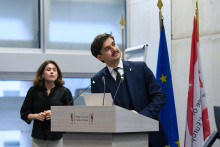
Final Conference of the POL Simulation Game, January 2025
A practitioner perspective on policymaking
The analytical and communication skills developed throughout the European Politics and Governance track are also central to professional work in transatlantic affairs. Students learn to understand institutional interests, navigate political constraints and communicate policy positions to different audiences.

“Effective transatlantic policymaking requires rigorous analysis, persuasive communication and the ability to navigate changing institutional and political environments.”
Professor Michael Koplovsky
Visiting Professor, MATA
Senior Advisor, Kreab International
Former senior US diplomat and trade negotiator
Shape your policy specialisation

Connect classroom study with institutional practice
Brussels
MATA students meet transatlantic stakeholders and explore the organisations shaping EU–US cooperation.
Strasbourg
European Politics and Governance students visit European and international institutions and connect their study of governance with institutional practice.

Meeting with College of Europe alumnus and MEP Thomas Pellerin-Carlin during the POL study trip, February 2026
Study at Fletcher
At Fletcher, students select courses from:
- International Law and Organizations;
- Diplomacy, History and Politics;
- Economics and International Business.
Students may also be able to substitute one Fletcher course with a relevant course elsewhere at Tufts University or Harvard University, subject to programme rules.
This allows students to complement their detailed knowledge of European governance with American and international perspectives on politics, law, diplomacy and economics.
Choose your second-year route:
Route 1: Fletchter > Internship | Route 2: Internship > Fletcher | Route 3: Full year at Fletcher |
- S3 Coursework
- S4 Internship
Internship: YES | - S3 Internship
- S4 Coursework
Internship: YES | - S3 Coursework
- S4 Coursework
Internship: NO |
| View route details | View route details | View route details |
Turn academic interests into professional experience
The MATA internship enables students to apply their understanding of institutions and policy in a professional environment. It can also help students refine their career interests and connect professional experience with their thesis topic.
Alumni profile
From a Washington internship to Brussels
Cecilia completed her MATA internship at the Tax Foundation in Washington, DC, where she continued working after graduation. She later transferred to the organisation’s Brussels office before moving to the European Commission, building a transatlantic career in economic and trade policy.
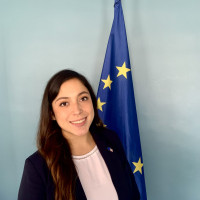
“MATA has been essential to my work in trade and economic policy. It gave me both the substantive knowledge to understand complex transatlantic issues and the practical skills to present them clearly and engage with different perspectives. Just as importantly, the programme gave me a deep understanding of the institutions, policymaking cultures, political dynamics and working methods on both sides of the Atlantic—an asset I draw on every day.”
Cecilia Perez Weigel, MATA ’23
Policy Officer, European Commission
MATA-POL: Where can this track take you?
The European Political and Governance Studies track prepares you to understand how institutions make decisions, how political interests shape policy and how European priorities connect with transatlantic and global developments. Its combination of institutional knowledge, policy specialisation, negotiation practice and professional experience can support careers in:
- EU institutions, bodies and agencies;
- national government and public administration;
- parliamentary and political affairs;
- public policy and regulatory affairs;
- consulting and public affairs;
- think tanks and policy research;
- civil society and interest representation;
- climate, energy, digital and economic policy;
- international organisations;
- political communication and project management.
Through study in Bruges and at Fletcher, an intensive EU negotiation simulation, study trips, an internship and a transatlantic thesis, students learn to analyse policy choices, represent different interests and contribute to decision-making in complex institutional environments.
Career paths vary according to each student’s academic interests, prior experience, internship choices and professional objectives. The examples above illustrate sectors and functions for which the track develops relevant knowledge and skills.
[Apply to MATA]