Understand today’s security challenges. Develop strategic judgement. Study from both sides of the Atlantic.
The European Security and Strategy Study Track combines an interdisciplinary understanding of European security with a transatlantic perspective developed at the College of Europe in Natolin and The Fletcher School at Tufts University.
Students examine how political, military, economic, technological and societal developments shape the security of Europe and its transatlantic partners. Through courses in strategy, conflict, defence, resilience, intelligence, technology and regional security, they develop the analytical and professional skills needed to assess complex threats and contribute to informed policy responses.
Natolin + Fletcher · Security and strategic studies · Regional expertise · Simulations and study trips · Internship and thesis
[Explore the curriculum]
[Compare the second-year routes]

An exchange at the High-Level Youth Dialogue with EU Commissioner for Trade and Economic Security Maroš Šefčovič in Natolin on 3 February 2025
Why choose European Security and Strategy?
Understand security in all its dimensions
Security today extends beyond military defence. It encompasses economic resilience, technology, energy, intelligence, information, infrastructure, institutions and society. The track develops an integrated understanding of how these dimensions interact in Europe and across the Atlantic.
Develop strategic judgement
Study the theories and practice of strategy, conflict and warfare while learning to assess risks, interests, capabilities and possible courses of action. Courses and seminars address strategic planning, foresight, crisis management and the relationship between political objectives and policy choices.
Examine European and transatlantic security together
Explore the respective roles of the European Union, NATO, national governments and other international actors. The shared MATA curriculum and study at Fletcher help students compare European and American perspectives on security and international affairs.
Study security from a distinctive regional perspective
Natolin’s location and academic expertise offer particular insight into Central, Eastern and Northern Europe, the EU’s neighbourhoods and NATO’s north-eastern flank. Students place current security questions within their wider historical, political and regional contexts.
Connect analysis with practice
Simulation exercises, compact seminars, masterclasses, regional study trips and a high-level internship allow students to move from understanding security problems to formulating and communicating practical responses.
What will you learn?
The track combines MATA’s programme-wide learning outcomes with specialised knowledge of European security, defence and strategic affairs.
Analyse security from multiple perspectives
Bring together political, military, legal, economic, historical and societal perspectives to understand complex security challenges and the connections among them.
Apply strategic concepts
Use theories of war, strategy, power and conflict to assess contemporary developments, identify competing interests and evaluate policy options.
Understand European and transatlantic security institutions
Examine how the EU, NATO, national governments and other international actors contribute to defence, crisis management, resilience and strategic cooperation.
Evaluate conventional and emerging threats
Assess subjects including interstate conflict, hybrid warfare, terrorism, nuclear strategy, disinformation, economic coercion and the security implications of technological change.
Place current challenges in regional and historical context
Understand how history, geography, political systems and regional developments influence the security concerns and strategic choices of European and transatlantic actors.
Develop policy-oriented responses
Process complex information, assess risks and constraints, and formulate clear, feasible and evidence-based recommendations for academic and professional audiences.
Communicate and collaborate effectively
Build the writing, presentation, teamwork and intercultural skills needed to contribute responsibly in national, European and international professional settings.
[View the full MATA intended learning outcomes]
Your first year at Natolin
| Semester 1 | Semester 2 |
Foundations in security and strategy The first semester builds a broad intellectual foundation. Introductory courses in political science, international relations, law, economics, European integration, interdisciplinarity and European history help create a common basis for students from different academic backgrounds. Students may be exempted from selected introductory courses by passing the relevant tests. Students then combine a compulsory course on the history of Central and Eastern Europe with core courses in European institutions, law, economics, geopolitics, EU power or theories of war and strategy. They also begin the shared MATA course on US–EU relations, prepare their thesis proposal and start planning their internship. Core areas - European institutions, law and economic governance;
- geopolitics and the sources of European power;
- theories of war and dimensions of strategy;
- Central and Eastern European history;
- multidisciplinary analysis of transatlantic affairs.
Contextual learning Students select contextual courses addressing subjects such as: - military strategy;
- the use of force in international law;
- ethics and religion in armed conflict;
- Cold War strategy;
- security and defence in European historical documents;
- the relationship between the state and the economy.
Optional masterclasses, research training and simulation exercises provide further opportunities to develop practical and analytical skills. | Security challenges and strategic application In the second semester, students deepen their expertise through specialist courses in security and strategy. They select three courses from the track and one course from the European Regional Studies programme, enabling them to combine thematic expertise with detailed regional knowledge. They also take two compact seminars and participate in a study trip. The shared MATA course moves from multidisciplinary analysis to practical work on transatlantic security and trade. Students continue developing their thesis proposal and preparing for the professional internship. |
[View Semester 1 courses and ECTS]
Compulsory MATA courses Study Trip: Coordinator: Ewa Ośniecka-Tamecka; Professors: Georges Mink, Andriy Tyushka, Thomas Mayr-Harting, Marek Cichocki, Sławomir Dębski & Pascaline Winand, Study Trip Modules, 2 ECTS Introductory Courses (no ECTS) - Sebastian Steingass & Amel Hammami, Introduction to Political Science, 10h
- Tobias Schumacher, Introduction to International Relations, 10h
- Peter Van Elsuwege, Introduction to Law, 10h
- Barbara Bobrowicz, Introduction to Economics, 10h
- Wolfgang Wessels, Introduction to Theories and Strategies of European Integration, 10h
- Rick Szostak, Introduction to Interdisciplinarity and Transdisciplinarity, 10h
- Edward Hunter Christie, Elementary Foundations in Economics and Econometrics, 10h
- Richard Butterwick-Pawlikowski, History of European Civilization, 10h
Compulsory EIS course
Assessed core courses: Stefan Auwer, The Sources of EU Power in Times of War, 4 ECTS Luiza Bialasiewicz, Geo-politics, 4 ECTS Beatrice Heuser , Theories of War and Dimensions of Strategy, 4 ECTS
Study Trip: Coordinator: Ewa Ośniecka-Tamecka; Professors: Georges Mink, Andriy Tyushka, Thomas Mayr-Harting, Marek Cichocki, Sławomir Dębski & Pascaline Winand, Study Trip Modules, 2 ECTS
Non-assessed contextual courses (up to 2 may be selected, no ECTS): Lukas Milesvski, Making Sense of Military Strategy Dieter Schlenker, External Relations, Security and Defence through the Prism of EU Historical Documents Antonino Ali, The Use of Force in International Law Fadi Daou, Ethics and Religion in Armed Conflicts Marek Aleksander Cichocki and Slawomir Debski, Cold War Strategies from the Central Eastern Europe Perspective
Non-assessed seminar (no ECTS): Sebastian Steingass (coordinator), Barbara Bobrowicz, Natalia Chaban, Theofanis Exadaktylos, Kerry Longhurst, Georges Mink, Jason Rozumalski, Rick Szostak, Peter Van Elsuwege, Matia Vannoni, Pascaline Winand, Research Strategies and Tools
Non-assessed masterclass option: Oana Lungescu, Communicating Security Rajmund Andrzejczak, Military Security
Simulation game (No ECTS): Georges Mink & Marek Aleksander Cichocki, Drafting a Peace Treaty for the End of the Cold War Tobias Schumacher, EU Foreign Policy-Making in Times of Conflict in the EU's Neighbourhood
| [View Semester 2 courses and ECTS]
Compulsory MATA courses: Study Trip: Coordinator: Ewa Ośniecka-Tamecka; Professors: Georges Mink, Andriy Tyushka, Thomas Mayr-Harting, Marek Cichocki, Sławomir Dębski & Pascaline Winand, Study Trip Modules, 2 ECTS Voluntary courses for all majors: Cooperation with external partners Elzbieta Mikos-Skuza, Introduction to International Humanitarian Law within the framework of a seminar organized with the International Committee of the Red Cross - open to external participants Workshops in history organized in cooperation with the Max Weber programme of the European University Institute
Specialist courses for the ESSST option: Gustav Gressel, Security and Conflict Management, 4 ECTS Edward Stoddard, Changing Character of Warfare from Antiquity to the Present Day, 4 ECTS Beatrice Heuser, Strategy, Planning and Foresight, 4 ECTS Andrew Michta, Security and Military Challenges in Europe, 4 ECTS Thierry Tardy, L’environnement Stratégique européen : évolutions et défis futurs, 4 ECTS Maciej Popowski, Building Resilience of the EU, 4 ECTS Alan Riley, EU Security in an Economic Context, 4 ECTS Edward Hunter Christie, Defence Economics and Defence Innovation, 4 ECTS Arndt Freytag von Loringhoven, Challenges of Multilateralism and Intelligence Cooperation, 4 ECTS Jeffrey Michaels, Nuclear Strategy, 4 ECTS Tomas Jermalavičius, Terrorism and Hybrid Warfare, 4 ECTS Dominik Jankowski, The Geopolitics of Technology, 4 ECTS Jakub Kalensky, The Geopolitics of Disinformation: Russia, the Neighbourhoods, the Euroatlantic. What is the Threat and how to Counter it?, 4 ECTS
Compact seminars for the ESSST option (no ECTS) Pierre Vimont, The EU and Crisis Management in Practice Rodolphe Munoz, EU Space Policy Francesco Zampieri, Maritime Geopolitics Luca Franza, Energy Security and Conflict in the EU’s Neighbourhood Olivier Corff, China’s National Security and Military Policy Maria Shagina, Sanctions and Economic Statecraft
Simulation game for the ESSST option (no ECTS): Richard Butterwick-Pawlikowski, Creating a System of European Security: The Congress of Vienna 1814-15 Thierry Tardy, NATO and the EU’s Response to War in Europe
|
Learn through simulations and strategic exercises
The track connects academic study with applied learning. Through simulations, students confront competing interests, incomplete information and difficult strategic choices.
Activities currently planned include exercises on:
- negotiating a settlement at the end of the Cold War;
- EU foreign-policy decision-making during conflict in its neighbourhood;
- the creation of a European security system;
- NATO and EU responses to war in Europe.
These experiences help students develop:
- strategic analysis;
- negotiation and coalition-building;
- decision-making under uncertainty;
- policy communication;
- teamwork;
- the ability to connect historical experience with contemporary challenges.
Learn from academics and practitioners
The track brings together scholars and practitioners with expertise in strategy, conflict, military affairs, resilience, intelligence, technology, economics and regional security.
Masterclasses and compact seminars provide opportunities to engage with professionals working on subjects such as communicating security, military strategy, crisis management, space policy, maritime geopolitics, energy security and economic statecraft.
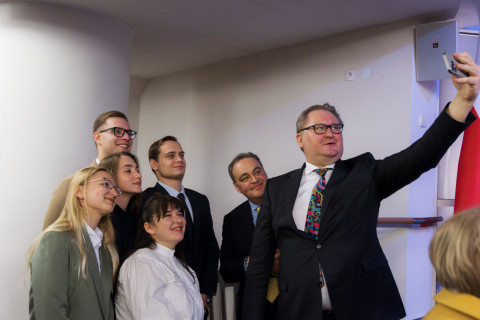
Natolin students meeting Mr Taras KACHKA, Deputy Prime Minister of Ukraine for Europea and Euro-Atlantic Integration in February 2026
A shared transatlantic classroom
All MATA students participate in a year-long course on US–EU relations.
In the first semester, students develop a multidisciplinary understanding of transatlantic affairs. In the second, they apply that knowledge to questions of security and trade through collaborative, policy-oriented work.
For European Security and Strategy students, the course provides a common transatlantic framework through which to compare:
- European and American interests;
- the roles of the EU and NATO;
- institutional and political constraints;
- different strategic cultures;
- shared and divergent responses to security challenges.
From security analysis to policy advice
Security and strategic decision-making require more than understanding institutions and threats. Through policy projects and simulations, students learn to assess competing interests and formulate feasible responses under complex conditions.

“Students learn how to define core interests, reconcile competing priorities, identify necessary trade-offs, build consensus and develop concrete policy recommendations.”
Professor Benedetta Berti
Visiting Professor, MATA
Secretary General, NATO Parliamentary Assembly
Examine security in its regional context
Study trips are an integral part of the track. They allow students to connect academic analysis with the political, historical and social realities of particular regions.

Natolin students during their visit to the Organization for Security and Cooperation in Europe (OSCE) Office for Democratic Institutions and Human Rights in April 2025

Natolin students visit the UNHCR office in Warsaw in April 2025
Through meetings, field visits and group work, students can examine how security questions are understood by:
- public officials;
- international organisations;
- policy experts;
- civil-society representatives;
- regional and local actors.
Students at the College of Europe also participate in the MATA study trip to Brussels, where they meet stakeholders working on transatlantic issues.
Continue your studies at Fletcher
At The Fletcher School, students can complement their Natolin specialisation with courses across three areas:
- International Law and Organizations;
- Diplomacy, History and Politics;
- Economics and International Business.
Students ordinarily select four courses in a Fletcher semester and may substitute one with an eligible course from elsewhere at Tufts University or Harvard University, subject to programme rules.
This flexibility allows students to broaden or deepen their interests in areas such as:
- international security;
- strategy and foreign policy;
- international institutions and law;
- economic security;
- technology policy;
- conflict and negotiation;
- regional studies.
Choose your second-year route
Route 1: Fletchter > Internship | Route 2: Internship > Fletcher | Route 3: Full year at Fletcher |
- S3 Coursework
- S4 Internship
Internship: YES | - S3 Internship
- S4 Coursework
Internship: YES | - S3 Coursework
- S4 Coursework
Internship: NO |
| View route details | View route details | View route details |
For the routes including professional experience, the internship is worth 25 ECTS and should last ideally four months and at least three months. Students starting at the College are encouraged to undertake it in the United States.
Put your knowledge into practice
The high-level MATA internship enables students to apply their security and strategic expertise in a professional environment. Depending on their interests and approved placement, relevant settings may include:
- international and European institutions;
- national government and public administration;
- security and defence organisations;
- think tanks and research institutes;
- consultancies and political-risk organisations;
- technology, energy and defence-related sectors;
- civil-society organisations.
A security career through MATA
"Before the launch of the European Security and Strategy track, MATA graduates were already building careers in security and defence. Gautier Parthon de Von’s pathway has included a MATA internship connected to Ukraine, parliamentary work on European affairs, service in the Belgian Navy Reserve and a role in European aerospace, security and defence industry policy." - Gautier Parthon de Von, MATA ’24, Graduate of MATA-IRD
[Read the Fletcher profile]
Develop your own area of expertise
The MATA master’s thesis enables students to investigate a transatlantic question in depth, drawing on academic guidance from both institutions.
Possible fields could include:
- NATO and EU security cooperation;
- defence innovation and industrial policy;
- economic security and sanctions;
- resilience and hybrid threats;
- strategic communication and disinformation;
- technology and security;
- energy and critical infrastructure;
- nuclear strategy and arms control;
- regional security in Central and Eastern Europe;
- conflict management and crisis response.
MATA-ESSST: Where can this track take you?
The European Security and Strategy track prepares you to assess conventional and emerging security challenges, understand the institutions shaping European and transatlantic security, and develop evidence-based strategic responses. Its interdisciplinary curriculum and professional experience can support careers in:
- international and European institutions;
- national foreign, security and defence ministries;
- transatlantic and multilateral organisations;
- security and defence policy;
- crisis management and resilience;
- think tanks and strategic research;
- intelligence and geopolitical-risk analysis;
- defence innovation and economic security;
- technology, energy and infrastructure security;
- strategic communication and counter-disinformation;
- consulting, civil society and academic research.
Through study at Natolin and Fletcher, simulations, regional study trips, specialist seminars, a high-level internship and a transatlantic thesis, students develop the strategic judgement, contextual knowledge and communication skills needed to contribute responsibly in complex security environments.
Career paths vary according to each student’s academic interests, prior experience, internship choices and professional objectives. The examples above illustrate sectors and functions for which the track develops relevant knowledge and skills.
[Apply to MATA]